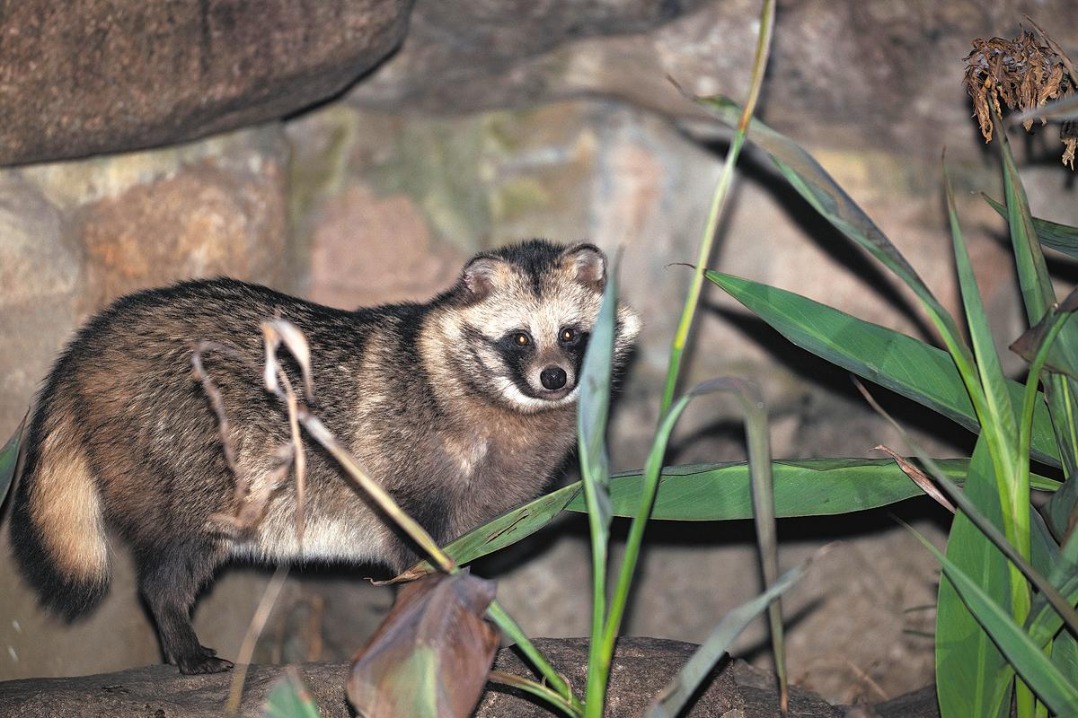
As global biodiversity conservation emerges as an urgent priority, Shanghai has emerged as an unexpected model of harmony between urban residents and native wildlife, with the city’s wild raccoon dog population finding a sustainable balance that has cut human-animal conflict dramatically, new research shows.
The latest collaborative census conducted by the Shanghai Forestry Station, Fudan University’s Institute of Biodiversity Science and the Shan Shui Conservation Center, released publicly on November 30, puts the city’s total raccoon dog population at a stable 3,000 to 5,000 individuals. Despite being a nationally protected species that continues to expand its range across the metropolis, localized population densities in crowded residential neighborhoods have dropped to all-time lows — a shift researchers credit to targeted policy interventions and shifting public attitudes.
Despite their characteristic dark facial markings that give them the common nickname of “bandit mask” raccoons, raccoon dogs are not closely related to North American raccoons. A unique ancient lineage of the Canidae family, which also includes wolves, foxes and domestic dogs, raccoon dogs are native to East Asia and stand out as the only canid species that hibernates through cold winter months.
While the overall population has stabilized, the species continues to gradually expand into new areas of the coastal megacity: wildlife observers first confirmed the presence of raccoon dogs on Chongming Island in 2024, and documented their arrival in Putuo District just last summer. These range expansions are a natural sign of a recovering, healthy population, researchers note, rather than a signal of overpopulation.
Wang Fang, director of Fudan University’s Institute of Biodiversity Science and lead researcher on the census, explained that the sharp drop in conflict and stable population stem from three years of targeted ecological improvements and public engagement. Better urban waste management has cut off easy access to food waste that once drew large groups of raccoon dogs into residential areas, while clearer guidance for residents has reduced unsupervised stray cat feeding that also supported unnaturally dense raccoon dog populations.
Beyond infrastructure and policy changes, Wang noted that transparent data sharing has played a critical role in shifting public perception of the small canids. Once widely labeled as a nuisance pest that posed risks to urban residents, raccoon dogs are now increasingly viewed as a welcome part of the city’s urban biodiversity. With clear data confirming the population is under control and the species poses no direct threat to human safety, a growing share of Shanghai residents now embrace the principle of peaceful coexistence with the native animals.
This success story comes as part of a broader national push in China to protect native biodiversity and develop sustainable models for integrating wildlife conservation into densely populated urban areas. As more cities around the world grapple with returning wildlife populations adapting to urban environments, Shanghai’s experience offers a actionable framework for balancing human life and native species conservation.