An international research consortium led by Chinese scientists has achieved a groundbreaking quantification of Earth’s most extreme climatic period, revealing unprecedented details about the ‘snowball Earth’ epoch approximately 700 million years ago. Published in Nature Communications, their study provides the first direct temperature measurements of ancient oceans during this planetary deep freeze.
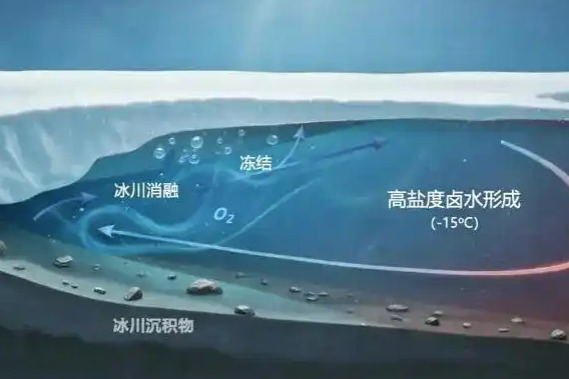
The investigation determined that continental margin waters—critical zones for early biological activity—maintained temperatures between -22°C and -8°C despite global glaciation. This remarkable liquid state persisted due to salinity levels quadruple those of contemporary seawater, creating a natural antifreeze effect that prevented complete solidification.
Dr. Lu Kai, lead author and postdoctoral researcher at the Chinese Academy of Sciences’ Institute of Geology and Geophysics, emphasized the significance: ‘These represent the coldest ocean temperatures ever recorded in Earth’s history, surpassing even Antarctica’s modern supercooled lakes.’
The team employed innovative paleothermometry techniques analyzing iron isotopes within ancient glacial marine sediments. These isotopic signatures function as geological thermometers, preserving temperature data through atomic abundance variations that correlate with thermal conditions.
Dr. Lu explained the mechanism: ‘High salinity enabled liquid water persistence through processes similar to contemporary Antarctic ice shelf circulation. During freeze-thaw cycles at ice sheet bases, salt exclusion created concentrated brines with depressed freezing points.’
This research fundamentally advances understanding of how primordial life endured extreme cryogenic conditions while offering new perspectives on Earth’s climate resilience mechanisms. The findings establish critical parameters for modeling past climate transitions and evaluating biological tolerance thresholds during planetary-scale environmental crises.