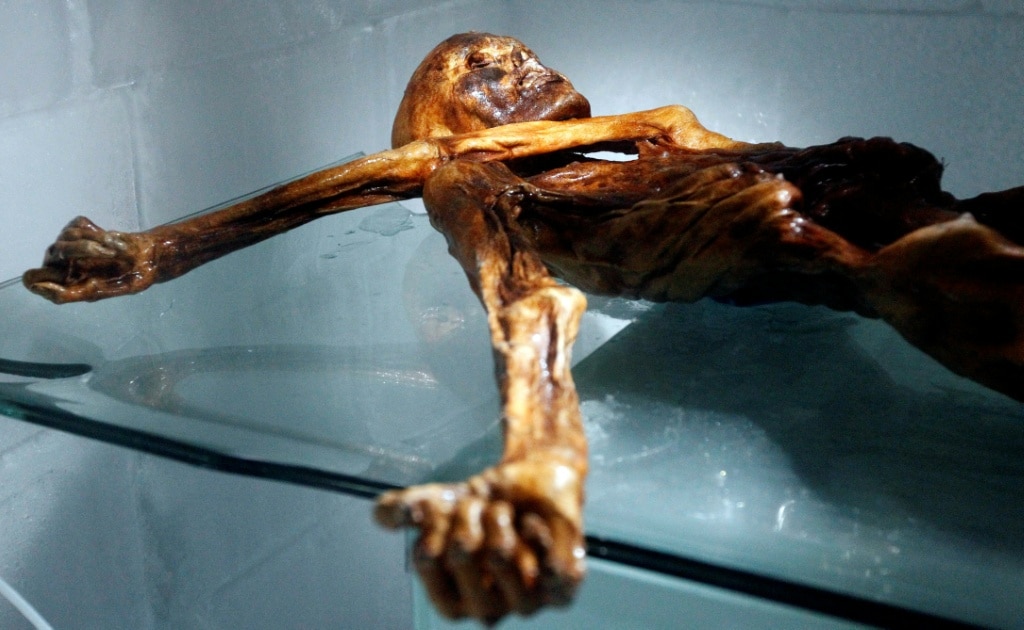
More than five millennia before the present day, long before the final stones were placed on Egypt’s Great Pyramids, a Bronze Age traveler now known to the world as Ötzi the Iceman was fatally shot with an arrow through the back while crossing the Alpine tundra along the Austria-Italy border. His frozen corpse lay undisturbed deep in glacial ice for 5,300 years, until two German hikers accidentally uncovered his remarkably preserved mummy in Italy’s South Tyrol region in 1991.
Since that landmark discovery, Ötzi has been stored at a constant -6°C, replicating the frigid conditions of his glacial tomb to preserve his body for ongoing research. As one of the most intact ancient human mummies ever found, he has provided scientists with an unparalleled view of daily life, diet, and health during the Neolithic period. Now, a new study published Wednesday in the journal *Microbiome* has uncovered a surprising twist: Ötzi’s remains host active ancient and modern microbial communities, including four strains of cold-adapted yeast living in his gut, skin, and the meltwater that leaches from his partially thawed body.
Lead researcher Mohamed Sarhan, a microbiologist at the Eurac Research Institute in Bolzano, Italy, told reporters that the presence of surviving yeast was completely unexpected. “What we didn’t expect to find was yeast,” Sarhan explained in an interview with Agence France-Presse. All four isolated yeast strains are adapted to survive sub-zero temperatures, a rare trait most commonly seen in yeast communities native to extreme environments like Antarctica. Researchers say this confirms the yeast colonized Ötzi’s body after his death, rather than being part of his original living gut microbiome. Genetic testing showed that the yeast’s DNA damage levels are consistent with ancient microorganisms embedded in the Iceman’s tissues, leading the study team to conclude colonization occurred shortly after Ötzi died and froze.
“These yeasts have accompanied Oetzi on his long journey through the millennia,” said study co-author Frank Maixner in a public statement about the findings. After isolating the yeast strains, the team replicated them in cold laboratory conditions stored in a standard refrigerator. When word of the yeast discovery spread, the team faced the inevitable question: could this 5,000-year-old yeast be used to bake bread?
Initial baking attempts failed, but after three months of tweaking growing conditions and fermentation techniques, the team produced what Sarhan described as a “very, very good sourdough” loaf. When asked about future experiments, Sarhan joked that brewing beer with the ancient yeast is already “on the list” of upcoming projects. Beyond the novelty of baking with ancient yeast, the discovery holds serious practical applications for environmental science. After Ötzi was first discovered in 1991, conservation teams treated his body with phenol, a common chemical preservative used to stop fungal growth on cadavers. The team found that the isolated yeast can consume and break down phenol, meaning related strains could one day be used to remediate phenol contamination in polluted soil and water systems.
The yeast discovery is not the only groundbreaking insight from the new analysis of Ötzi’s microbiome. Researchers also identified a strain of gut bacteria in Ötzi’s intestines that is virtually absent in the gut microbiomes of people living in industrialized nations today. The same bacteria has only been found in isolated indigenous tribes across Africa and South America, and in 3,000-year-old preserved feces recovered from a Bronze Age salt mine in Hallstatt, Austria — one of the few other existing samples of ancient human gut microbes. Sarhan noted that Ötzi and the Bronze Age salt miners ate far more fiber and whole grains than the average modern person, a dietary difference that likely explains the presence of this now-rare bacteria.
The study upends the long-held view of Ötzi as a static “frozen time capsule” of Neolithic life, instead framing his mummy as a dynamic, ongoing complex ecosystem that continues to evolve thousands of years after his death. Researchers note that it remains too early to confirm whether the active yeast communities are causing any long-term degradation to Ötzi’s remains, and have called for additional long-term study to monitor microbial activity in the mummy.
Not all independent experts have fully accepted the study’s conclusion that the yeast has been active in Ötzi’s body for millennia. Nikolay Oskolkov, a researcher at the Latvian Institute of Organic Synthesis who was not involved in the new study and previously discovered ancient fungus in Ötzi’s gut, called the finding that the Iceman’s microbiome is not “frozen” scientifically interesting. However, he cautioned that yeast samples were only collected in 2010 and 2019, meaning there is limited evidence to confirm the yeast has been multiplying continuously over thousands of years. Oskolkov argued the yeast may be relatively recent colonizers of the mummy’s body rather than long-term inhabitants that survived with Ötzi since the Copper Age.