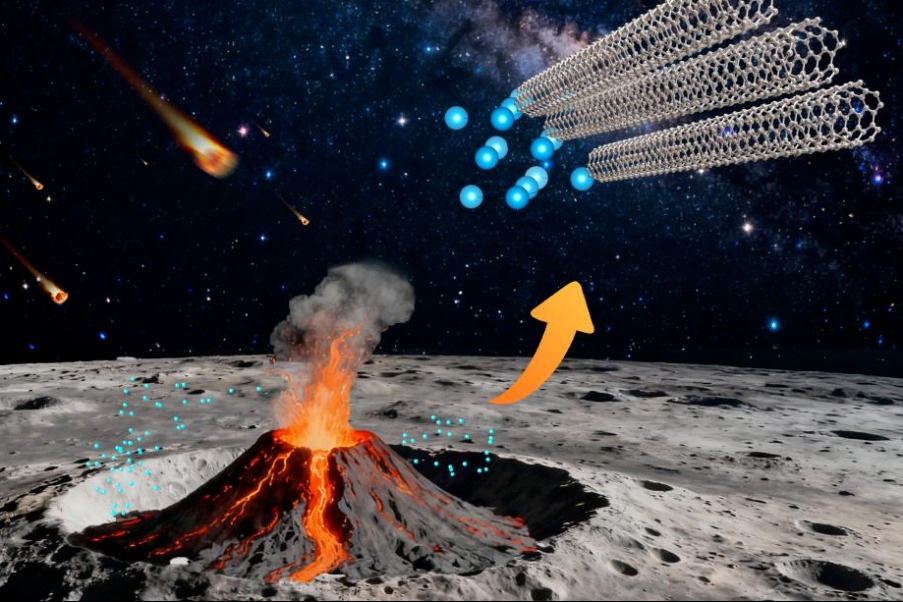
In a landmark discovery with profound implications for planetary science, Chinese researchers have confirmed the natural formation of single-walled carbon nanotubes and graphitic carbon within lunar samples retrieved by the Chang’e-6 mission. The China National Space Administration officially announced these findings on Tuesday, revealing unprecedented insights into the moon’s geological complexity.
A scientific team from Jilin University employed advanced microscopic and spectroscopic methodologies to conduct a comprehensive examination of far-side lunar material. Their investigation yielded the first definitive verification of naturally occurring graphite carbon on the lunar surface, simultaneously tracing its probable formation mechanisms and evolutionary trajectory.
This research achieves dual historical significance: it establishes the first international confirmation that single-walled carbon nanotubes can form through natural processes without anthropogenic intervention, while simultaneously demonstrating the sophisticated high-energy physico-chemical activities occurring on the lunar surface. The evidence points toward more dynamic geological processes on the moon’s far side than previously understood.
The study proposes that nanotube formation likely resulted from iron-catalyzed reactions driven by multiple extraterrestrial factors throughout lunar history. These include persistent micrometeorite bombardment, ancient volcanic phenomena, and continuous solar wind irradiation—collectively creating extreme conditions that enabled nature’s synthesis of advanced carbon structures.
Comparative analysis between Chang’e-6’s far-side samples and Chang’e-5’s near-side specimens revealed distinctive structural differences. Carbon formations from the far side exhibited more pronounced defect characteristics, potentially indicating intensified micrometeorite impacts throughout the moon’s geological history. This discrepancy suggests previously unrecognized compositional and evolutionary asymmetries between the lunar hemispheres.
These groundbreaking findings, recently published in the prestigious journal Nano Letters, fundamentally reshape our understanding of lunar geology and demonstrate how extreme cosmic environments can spontaneously generate advanced nanomaterials through natural processes.