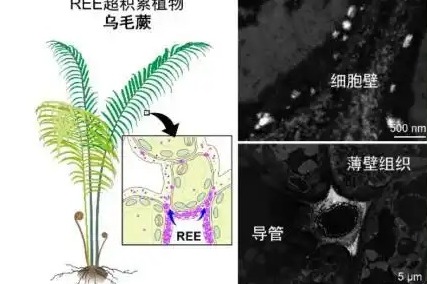
In a groundbreaking scientific breakthrough, a team of Chinese researchers has uncovered the phenomenon of rare-earth mineralization in ferns, marking the first time such a discovery has been made in the plant kingdom. This finding, published in the prestigious international journal *Environmental Science & Technology*, could revolutionize the extraction of rare earth elements (REEs) by offering a cleaner and more sustainable alternative to traditional mining methods. The study, led by Zhu Jianxi of the Guangzhou Institute of Geochemistry under the Chinese Academy of Sciences, focused on *Blechnum orientale*, an evergreen fern known as a hyperaccumulator plant. The researchers discovered that this fern not only absorbs and concentrates REEs from the soil but also facilitates their self-assembly into a mineral called Monazite-(La) within its tissue cells. This biomineralization process, previously observed only in microorganisms and animals, represents a significant leap in understanding plant mechanisms. Unlike traditional rare-earth mining, which often causes severe environmental damage, this plant-based approach could enable the recovery of valuable REEs while simultaneously remediating contaminated soil and restoring ecosystems. The discovery also highlights the potential of nearly a thousand known hyperaccumulator plants for sustainable resource utilization. The ‘biomonazite’ formed by *Blechnum orientale* is pure and nonradioactive, making it a promising candidate for green extraction methods. This research not only advances scientific knowledge but also offers a practical solution to the global challenges of resource scarcity and environmental degradation.