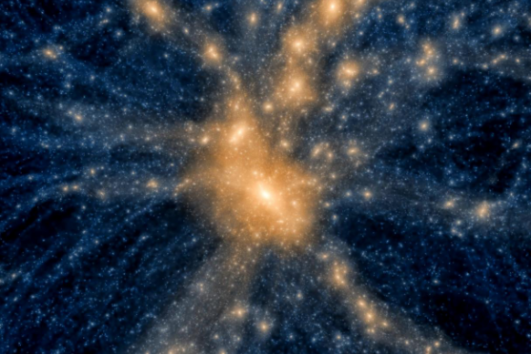
For decades, cosmologists have grappled with a fundamental challenge: how to reconstruct 13.8 billion years of cosmic evolution to test leading theories about dark matter, dark energy, and the origins of the large-scale structures that fill our universe. Now, a Chinese-led international research collaboration has delivered a groundbreaking tool to address that gap, unveiling HyperMillennium, the largest and most detailed cosmological simulation ever created. The project, which has already drawn praise from leading global astrophysicists, promises to reshape the future of cosmological research and support next-generation sky survey missions around the world.
HyperMillennium is far more than a simple digital model of the cosmos. Enclosed in a virtual cube measuring 12 billion light-years on each edge, the simulation tracks the gravitational interactions of 4.2 trillion virtual dark matter particles across 10 billion years of cosmic history. Using a well-established N-body numerical simulation technique, the team started their virtual model just moments after the Big Bang, then step-by-step traced how gravity pulled dark matter into the filamentous web of large-scale structures we observe in the modern universe. This digital replica of the cosmos allows researchers to rewind cosmic time, study the gradual formation of galaxies and galaxy clusters, and generate a comprehensive catalog of key galactic properties including positions, brightness, and structural traits when integrated with specialized galaxy formation physical models.
According to Wang Qiao, a researcher at the National Astronomical Observatories of the Chinese Academy of Sciences (NAOC), the project breaks new ground in three critical areas: force resolution, time accuracy, and overall computational scale. Unlike previous smaller simulations, HyperMillennium retains strong statistical power across its entire volume while enabling researchers to examine extremely rare, massive cosmic structures in unprecedented fine detail. This makes it a uniquely valuable tool for testing core theories that have shaped modern cosmology.
Pulling off a simulation of this magnitude required overcoming massive computational hurdles. Instead of relying on off-the-shelf software, the research team spent more than a decade developing and optimizing PhotoNs, a custom piece of code built specifically to run on China’s domestic supercomputing infrastructure. The final simulation ran on more than 10,000 accelerator cards, consuming over 100 million CPU core-hours and 10 million accelerator-card hours to generate roughly 13 petabytes of raw and processed data — a volume equivalent to thousands of high-definition feature films.
The breakthrough has already earned widespread acclaim from the international scientific community. Mike Boylan-Kolchin, a professor of astronomy at the University of Texas at Austin, described HyperMillennium as a true computational marvel. He noted that its unprecedented size and resolution will position it as a foundational reference for cosmological research across the globe for decades to come, helping researchers finally unlock long-held mysteries about dark energy and the conditions of the early universe. Volker Springel, director of the Max Planck Institute for Astrophysics in Germany, added that the project redefines the outer limits of what is possible in numerical cosmology. Springel said he was extremely impressed by the team’s ability to deliver such a large, highly accurate simulation, which will enable new high-precision tests of the standard cosmological model — the leading framework for understanding the origin and evolution of the universe.
The first peer-reviewed research paper from the HyperMillennium project was published recently in *Monthly Notices of the Royal Astronomical Society*, one of the field’s most prestigious journals. In a key validation test, the team compared the simulation’s output to real observational data of Abell 2744, a massive colliding galaxy cluster located roughly 4 billion light-years from Earth. The match between the simulation and real observation was remarkable, even down to the pixel level, confirming that the standard cosmological model holds up even in the most extreme, complex cosmic environments.
In a move that opens the project up to researchers worldwide, NAOC has already released the first batch of HyperMillennium simulation data to the global scientific community via the National Astronomical Data Center, a public platform dedicated to supporting open astronomy research, education, and data-driven scientific innovation. This open access policy ensures that researchers across the world can leverage the unprecedented power of HyperMillennium to advance their own work into the origins and nature of our universe.