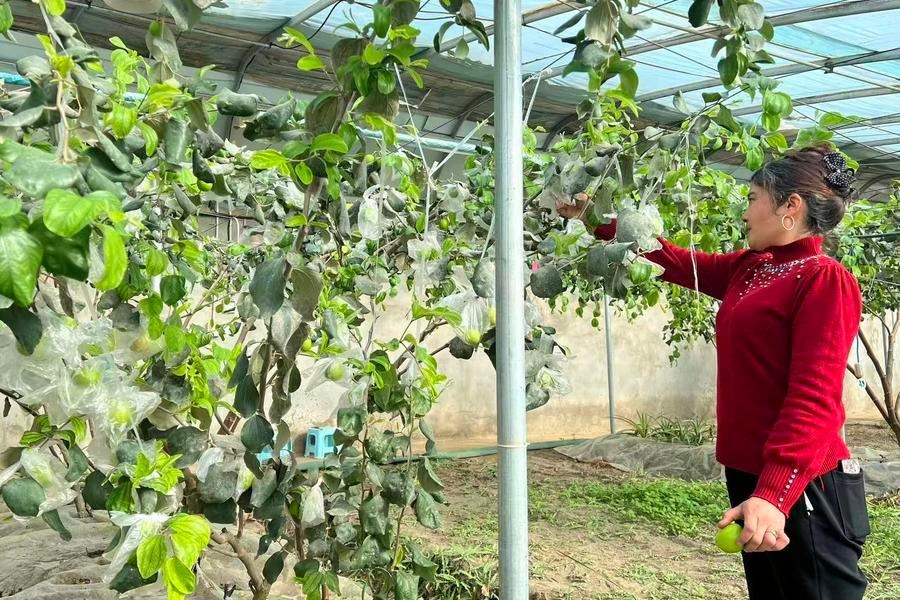
In a remarkable display of agricultural innovation, scientists from the Chinese Academy of Sciences have transformed the winter landscape of China’s Taklimakan Desert into a thriving oasis of summer produce. At the forefront of this transformation is Ayimak village in Moyu county, Hotan prefecture, where advanced greenhouse technologies defy the harsh desert winter with vibrant displays of trellised watermelons, plump grapes, and exotic dragon fruits.
The groundbreaking initiative, part of a rural vitalization project dating back to 2015, has established what local villagers call ‘scientific fields’ – a cluster of technologically advanced greenhouses that have become a regional attraction. According to Wang Shi, the village’s Party committee first secretary, over 40 of the village’s 122 greenhouses are now managed by the CAS project team, providing stable employment for more than 100 villagers with average monthly incomes exceeding 3,000 yuan ($430).
Wang Xin from the CAS Xinjiang Institute of Ecology and Geography explained the scientific advantages: ‘Compared to traditional open-field planting, our trellised watermelon method allows for higher density, greater yield and superior sunlight exposure. Southern Xinjiang’s abundant sunshine and heat resources provide ideal conditions for protected agriculture, which we’ve enhanced through advanced technology to significantly boost both yield and fruit sweetness.’
The research team has contracted eight greenhouses for pilot programs, testing various watermelon varieties to identify those best suited to local conditions. Wang Ping, another team member, has introduced over 50 fruit varieties including cherries, winter jujube, and pineapple, carefully selecting those most adaptable to the desert environment.
Through years of research, scientists have overcome significant challenges including soil salinization, compaction, and sand dust that previously limited fruit cultivation in southern Xinjiang. The project’s success has inspired local involvement, with villager Bayimai Abudouaini noting he has acquired valuable cultivation skills and hopes to rent his own greenhouse in the future.
The initiative aligns with regional development goals, as Xinjiang had established over 1.2 million protected agriculture units covering more than 44,600 hectares by 2023. According to Chinese Academy of Engineering academician Yu Jingquan, Northwest China’s abundant uncultivated land provides exceptional opportunities for expanding protected agriculture while reducing costs.
A joint work plan by the Ministry of Agriculture and Rural Affairs and Xinjiang’s regional government projects that protected agriculture in southern Xinjiang will reach an annual output value exceeding 9 billion yuan by 2028, creating employment for over 200,000 rural residents. This scientific achievement demonstrates how technological innovation can transform challenging environments into productive agricultural centers, providing economic opportunities while ensuring food security.