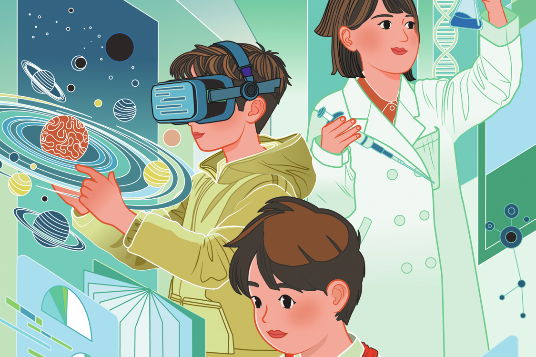
China has unveiled a comprehensive national guideline to revolutionize science, technology, engineering, and mathematics (STEM) education in primary and secondary schools. The initiative, jointly issued by the Ministry of Education and six other government departments on November 12, 2025, aims to develop students who “think like scientists and practice like engineers.”
The ambitious plan establishes clear milestones: by 2030, a structured science education system should be fundamentally established with enhanced curricula, teaching methodologies, evaluation mechanisms, and teacher development programs. By 2035, the vision expands to a fully matured science education ecosystem supported by social resources and widespread implementation of project-based, inquiry-driven, and interdisciplinary teaching approaches.
Tian Zuyin, Director of the Ministry’s Department of Basic Education, emphasized the graduated approach aligned with cognitive development. Early primary education will focus on experiential learning and curiosity stimulation, while upper primary grades advance to conceptual understanding and hands-on exploration. Middle school students will engage in practical inquiry around real-world problems, with high schoolers concentrating on experimental research and engineering practice involving cutting-edge advancements.
The guideline encourages innovative teaching models including “dual-teacher classes” featuring collaborations between scientists and classroom teachers, and “future classrooms” utilizing metaverse-based virtual laboratories. Assessment methods will evolve beyond exam-focused metrics to include process evaluation and digital profiles tracking students’ innovative growth.
To address implementation challenges, the policy promotes partnerships between schools, universities, research institutes, and technology enterprises. Teacher training will be enhanced through master’s programs in science education at top universities and specialized development for current educators. Experts from academic and research institutions will be encouraged to serve as part-time instructors.
Educators nationwide have welcomed the guideline as a transformative roadmap. Lu Yongli, Principal of Beijing No. 2 Experimental Primary School, noted the alignment with existing national science curricula that already include 78 compulsory inquiry experiments for primary students. In rural areas, teachers like Hu Guozhu from Yaoxiang Middle School in Hunan praised the emphasis on adapting to local conditions rather than copying urban models.
The human impact of this approach is already visible. Xia Jun’an, a fifth-grade student in Hangzhou, recently experienced the principles firsthand through designing and building a functional water clock using simple materials. “When the clock finally dripped evenly and timed three minutes successfully,” he recounted, “it felt like I could ‘touch’ time—it was no longer abstract, but right there in the rhythm of each drop.”
As the policy rolls out, educators believe that by making science more engaging, practical, and inclusive, China can lay the foundation for a new generation of curious, creative minds prepared to contribute to the nation’s scientific and technological future.