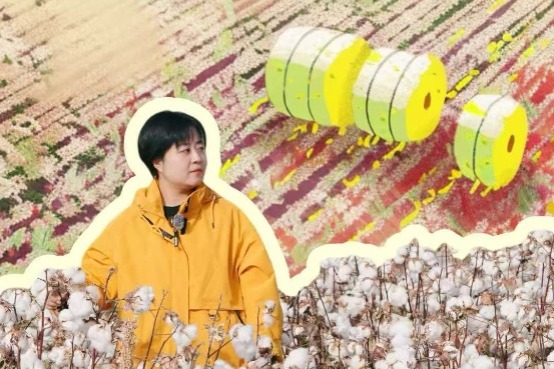
In the arid deserts of Dunhuang, Gansu province, a remarkable transformation is underway. Once barren and saline-alkali soil, deemed unsuitable for agriculture, now yields bountiful cotton crops, thanks to decades of scientific innovation. Local technician He Shengbing proudly refers to the 1,000-kilogram cotton bales as ‘golden eggs laid by what was once dead land.’
For years, nearly 95% of Dunhuang’s 25,000 hectares of farmland suffered from high salinity, low organic matter, and extreme alkalinity, making it nearly impossible for crops to thrive. However, through the efforts of researchers from China Agricultural University and local agronomists, the region has seen a dramatic turnaround.
Since May, Dunhuang has served as a pilot base for saline-alkali land management. Professor Hu Shuwen’s team developed a comprehensive soil improvement plan, combining organic fertilizers, biobased soil conditioners, microbial agents, and pH regulators. These are delivered through a precise drip irrigation system, which not only conserves water but also reduces soil salinity.
‘We’re not changing the cotton. We’re changing the earth it grows in,’ explained Yang Xu, a graduate student on Hu’s team. The drip irrigation system, with its tiny holes spaced every 30 centimeters, delivers water and nutrients directly to the roots, creating a ‘wet bulb’ effect that protects plants from salt buildup.
The results are undeniable. The organic content of the topsoil has increased to 1.35%, salt concentration has dropped to 0.12%, and cotton yields have risen by up to 20%. Additionally, the region saves 20% of its agricultural water annually.
Dunhuang’s success has garnered international recognition. Its ‘Five-in-One’ model, which unites the United Nations Food and Agriculture Organization, research institutes, local governments, enterprises, and farmers’ cooperatives, was highlighted at the Global Conference on Scientific Utilization and Development of Saline Soil as a replicable example of sustainable land management in arid regions.
With plans to invest 17 million yuan ($2.4 million) in 2025 to expand the program, Dunhuang is proving that even the harshest land can flourish with the right care. ‘Every drop counts here,’ Yang said. ‘We’re proving that even the harshest land can bloom with the right care.’