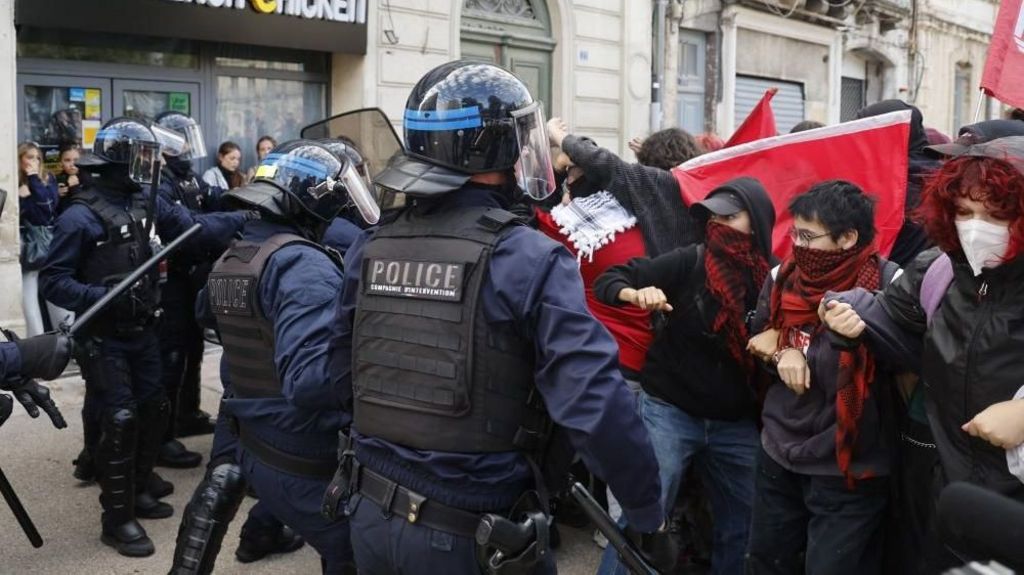
What began last week as a small, localized protest over failing education standards in Paris has exploded into a nationwide movement that has shut down more than 700 French secondary schools and sparked violent confrontations between demonstrators and riot police. High school students are leading the demonstrations, fueled by years of mounting frustration over persistent understaffing, overcrowded learning spaces, crumbling infrastructure, extended school hours, and planned national education budget cuts that threaten to worsen already strained conditions.
By Friday, the unrest had spread to major cities across the country, including Montpellier, Nantes, Marseille, Belfort, Strasbourg, Rennes, and multiple districts of the Paris metropolitan area. In many urban centers, protesters lit barricades and trash bins on fire, blocked roadways, and damaged school property. In the northeastern city of Belfort, a 17-year-old demonstrator was taken into custody on charges of attempted homicide following an attack that targeted a serving police officer. France’s Education Ministry confirmed that at least 65 school and law enforcement staff have been injured in the unrest across the country.
In the Parisian suburb of Pantin, police charged crowds of demonstrators and made multiple arrests after projectiles were thrown at officers. Local law enforcement deployed tear gas in Strasbourg to pre-empt escalating violence, per reports from Reuters. One of the hardest-hit sites was Nelson Mandela High School in Nantes, where a fire set by protesters destroyed the building’s glass entrance lobby and damaged multiple interior spaces, leaving an estimated €2 million ($2.1 million) in total damages. French authorities have confirmed that they seized dangerous contraband from demonstrators during raids, including homemade petrol bombs, an axe, and explosive mortar fireworks. The Education Ministry noted that hundreds of schools have suffered damaged gates, fences, and entrance facilities, labeled as “significant damage” to public education infrastructure.
For many participating students, the government’s heavy-handed law enforcement response has only amplified their anger. “As far as we’re concerned, we’ve won – our school is closed this morning,” 16-year-old protester Lola told AFP during Friday’s demonstrations. She added, “It makes us even angrier – the police have no right to hit us or use tear gas on us.”
The unfolding crisis comes at a critical political juncture for French President Emmanuel Macron, just six months ahead of the 2027 presidential election. Senior government officials have framed the unrest as a breakdown of public order, rather than a reflection of legitimate student grievances. French Justice Minister Gerald Darmanin confirmed that the situation has “gone from high-school student demonstrations to a public order disturbance.” He added that around 2,000 people, most of whom are minors, have been taken into custody since the movement began, and prosecutors have been instructed to seek financial damages from parents for destruction caused by their children.
French Education Minister Édouard Geffray claimed Friday that the original student movement had been “hijacked” by external agitators with no connection to the school system. He told French broadcaster BFMTV that multiple teachers reported “the people in front of me were not my students.”
Many parents across France have expressed growing anxiety about the unrest, fearful that their children will be caught up in escalating violence between protesters and police. In southern Paris, 53-year-old Anya told AFP she had forbidden her son from attending demonstrations but was searching for him after he left home. “We’re afraid the situation might escalate,” she explained.
Despite the government’s condemnation, multiple major French trade unions have publicly backed the student protesters and their demands. Three leading education and public service unions—SNEP-FSU, SNUEP-FSU, and Solidaires—have called on their members to support the movement. In an official statement, the Solidaires Trade Union Federation argued, “Let’s not let them fire on our children. Secondary school pupils have the freedom of assembly, association and demonstration.”