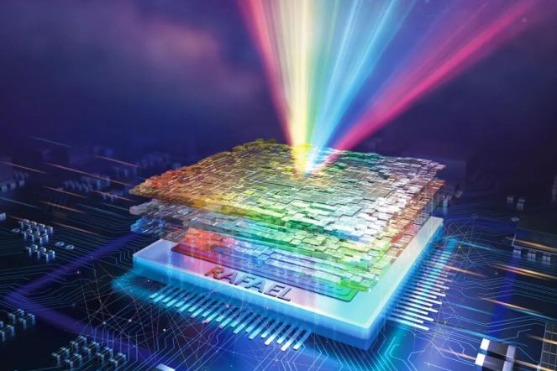
A groundbreaking spectroscopic imaging chip, RAFAEL, developed by a research team from Tsinghua University in China, has been unveiled, promising to transform humanity’s approach to observing the universe. Published in the prestigious journal Nature, this innovation resolves the long-standing challenge of balancing spectral resolution and throughput, enabling high-performance snapshot spectroscopy. Spectroscopy, a critical tool for analyzing the physical and chemical properties of matter, has traditionally struggled to achieve both ultra-high resolution and high efficiency simultaneously. RAFAEL, also known by its Chinese name “Yuheng,” overcomes this limitation through advanced lithium-niobate photonics, allowing each pixel in the sensor to capture complete spectral data with exceptional optical transmittance. The chip boasts a 10-megapixel spatial resolution and a spectral precision of 0.05 nanometers across visible to near-infrared wavelengths. In a recent demonstration, RAFAEL captured spectra of up to 5,600 stars in a single exposure, marking a hundredfold improvement in observational efficiency compared to leading astronomical spectrometers. Compact yet powerful, RAFAEL is poised to unlock new insights into cosmic phenomena such as dark matter and black holes, while advancing research in fields ranging from materials science to astrophysics. Professor Fang Lu, the corresponding author of the study, highlighted the chip’s potential to establish a new benchmark for astronomical observation. The name “Yuheng,” derived from the fifth star of the Big Dipper, symbolizes precision and balance, reflecting the chip’s mission to enhance humanity’s understanding of the universe.