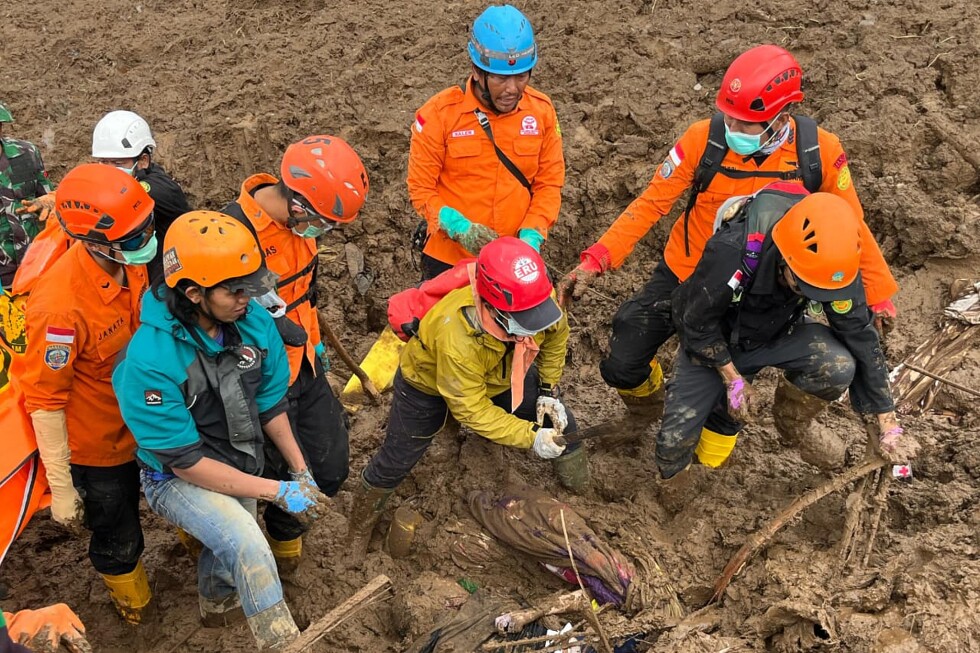
BANDUNG, Indonesia — Rescue operations intensified in West Java’s Pasir Langu village Sunday as improved weather conditions allowed emergency teams to continue searching for dozens missing following a devastating landslide. The disaster, which struck Mount Burangrang’s slopes before dawn Saturday, completely buried approximately 34 homes under massive mudflows, rocks, and uprooted trees.
Search and rescue coordinator Ade Dian Permana reported recovery efforts had yielded 25 confirmed fatalities by Sunday, with remains being carefully extracted using basic farm tools and manual labor due to unstable terrain preventing heavy equipment deployment. The 250-strong rescue team worked meticulously through mud mounds reaching 5 meters (16 feet) in height, with drones and K-9 units deployed to scan the extensive 2-kilometer (1.2-mile) landslide path.
The incident has displaced approximately 230 residents now sheltering in government facilities, while 72 individuals remain unaccounted for. At temporary relief centers, anxious families monitored updated missing persons lists as forensic teams worked to identify recovered remains for release to relatives.
Indonesian Vice President Gibran Rakabuming Raka visited the disaster zone Sunday, pledging governmental action to prevent future tragedies. He specifically urged West Bandung district officials to address problematic land conversion practices in high-risk areas.
Environmental organizations have characterized the catastrophe as fundamentally human-exacerbated. Wahyudin Iwang of Walhi West Java emphasized that Saturday’s landslide resulted from prolonged environmental degradation in the North Bandung Area conservation zone, where development projects have consistently violated spatial-planning regulations. This protected highland region serves as a critical water-catchment zone for the densely populated Bandung Basin, making ecological preservation imperative.
The disaster occurs during Indonesia’s annual rainy season (October-April), when the archipelago nation frequently experiences flooding and landslides. Millions reside in vulnerable mountainous regions and fertile floodplains across the 17,000-island chain.