Archaeological excavations in Jinan have fundamentally rewritten the historical timeline of Shandong’s provincial capital, revealing evidence of urban settlement dating back approximately 4,200 years—some 1,500 years earlier than previously established by conventional scholarship.
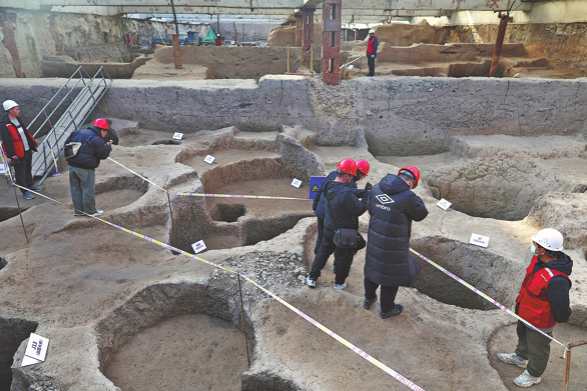
The groundbreaking discovery emerged during preliminary surveys for a subway project in April 2024, leading to the identification of the Daming Lake Southwest Site. After extensive excavation, archaeologists uncovered a remarkably preserved ancient wall from the Longshan culture period, alongside 206 structural features including defensive fortifications, moats, platforms, and residential foundations.
Professor Luan Fengshi of Shandong University’s School of Archaeology announced during a site press conference: “Carbon-14 dating conclusively places the construction of this Longshan culture city wall around 4,200 years before present, dramatically altering our understanding of Jinan’s origins which was traditionally dated to merely 2,700 years ago.”
The archaeological team has recovered over 460 artifacts crafted from diverse materials including pottery, porcelain, iron, copper, bone, stone, and wood, supplemented by more than 130 historical coins. Particularly significant are polished black pottery shards, including an exquisitely decorated eggshell-thin piece representing the pinnacle of Longshan craftsmanship.
A collection exceeding 1,000 boxes of ceramic fragments spans multiple dynasties, from the Dawenkou culture (approximately 5,000 years ago) through the Shang, Han, Tang, and Qing dynasties, providing unprecedented continuity of historical evidence.
The site features a human-modified moat to the west of the wall, originally a natural river channel measuring over 50 meters wide and nearly 10 meters deep. According to Guo Junfeng, director of Jinan’s archaeology institute, “The stratified silt layers—with Dawenkou pottery at lower levels and Longshan ceramics above—enable us to trace the site’s evolution through millennia.”
East of the wall, cultural layers indicate sustained urban activity not only during the Longshan period but continuing through the Warring States Period and subsequent dynasties. Additional significant findings include the foundation of a Song Dynasty Buddhist temple, providing physical evidence for researching religious development, temple architecture, and social beliefs of the era.
The site has undergone comprehensive 3D scanning and digital documentation, with a cross-section of the ancient wall removed for detailed study. Authorities plan to construct an on-site exhibition space to showcase these 4,000-year-old remains and share this revolutionary discovery with the public, according to Ren Xiaorui, deputy director of Jinan’s culture and tourism bureau.