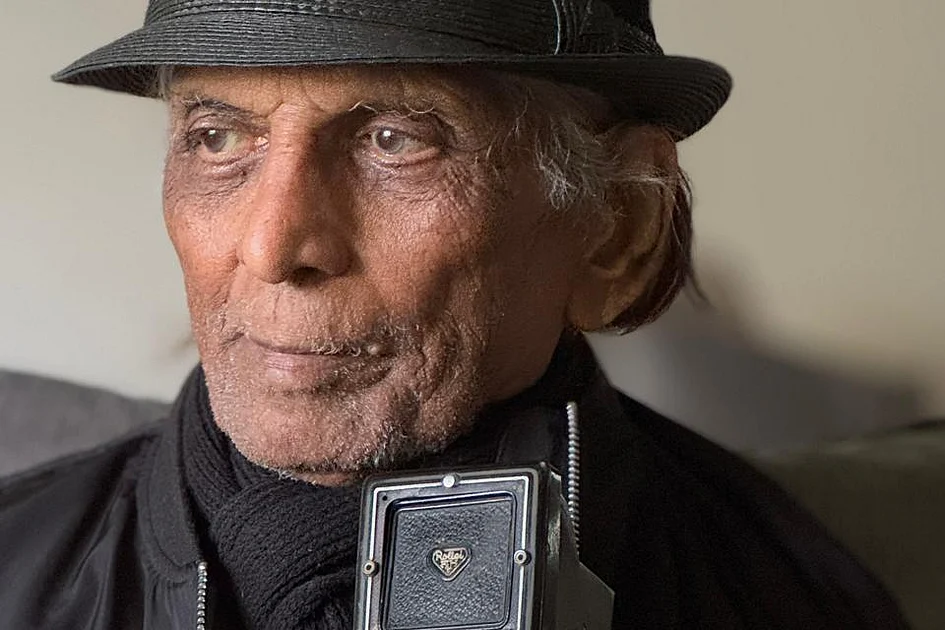
In 1965, a young Indian immigrant named Ramesh Shukla arrived in the United Arab Emirates carrying merely 50 rupees and a cherished Rolleicord camera—a parting gift from his father. The landscape that greeted him stood in stark contrast to the modern metropolis we know today: an expansive desert terrain devoid of highways, skyscrapers, or modern infrastructure.
Over the subsequent six decades, Shukla evolved into the nation’s most revered documentary photographer, earning the distinguished title of ‘royal photographer.’ His extraordinary journey began when his ship docked in Sharjah, where he encountered a vast, unfamiliar environment that would ultimately define his life’s mission: visually narrating the Emirates’ remarkable evolution.
Shukla’s pioneering work gained royal recognition in 1968 when he captured a spontaneous moment of the late Sheikh Zayed bin Sultan Al Nahyan during a camel race. The ruler’s reaction to the photograph proved transformative—personally signing the image, gifting Shukla a gold pen, and bestowing upon him the Arabic honorific ‘Fannan’ (artist). This encounter established Shukla as the trusted chronicler of the nation’s most significant historical events.
His defining moment arrived on December 2, 1971, at Union House, where he immortalized the gathering of rulers following the signing of the agreement that established the United Arab Emirates. This historic image, later celebrated as ‘The Spirit of the Union,’ achieved national icon status and was subsequently featured on the Dh50 banknote.
Shukla’s dedication transcended financial gain, driven instead by a profound passion for preserving history. His intimate access to the nation’s leadership included life-saving interventions, such as when Dubai Ruler Sheikh Mohammed bin Rashid Al Maktoum rescued him from potential trampling at a horse race after the photographer became engrossed in capturing the perfect shot.
Internationally, Shukla’s lens captured moments like Queen Elizabeth II’s 1979 visit to the UAE, where his persistence yielded a cherished solo portrait of the monarch. His extensive archive now resides in prestigious institutions including the Etihad Museum and Al Shindagha Museum, while his imagery adorns Dubai Metro stations, embedding his visual legacy into the nation’s collective consciousness.
Despite documenting unprecedented transformation, Shukla maintained pride in preserving Emirati cultural essence and traditions. At the time of his passing, his unpublished work included undeveloped film rolls containing unseen fragments of the nation’s journey—a testament to his belief that history remains perpetually unfolding, with stories forever waiting to be revealed through the photographic lens.