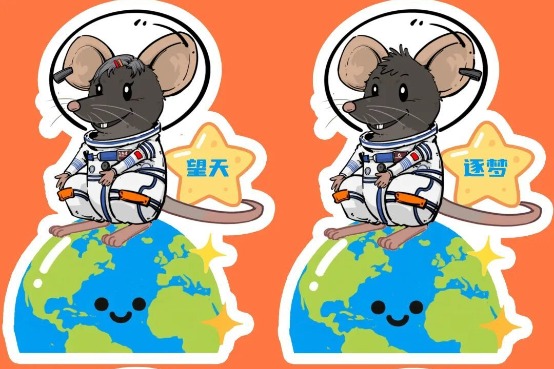
In a remarkable fusion of public engagement and space science, China has officially named four pioneering mice that recently completed an orbital mission aboard the nation’s space station. The Chinese Academy of Sciences revealed the selected names—Wangtian (gaze at the sky), Lanyue (reach for the moon), Zhuiyun (chase the clouds), and Zhumeng (follow the dream)—during a special public science event on Saturday.
The naming initiative formed part of an innovative public outreach campaign orchestrated by Xinhua News Agency, which invited citizens to propose and vote on names for the rodent astronauts. The four selected mice, originally identified as numbers 6, 98, 154, and 186, were chosen from a pool of 48 candidates for their historic space voyage.
Launched aboard the Shenzhou XXI crewed spacecraft on October 31, the mice spent approximately two weeks in microgravity conditions before returning safely to Earth with the Shenzhou XX crew on November 14. The mission represents China’s continuing advancement in space biological research, particularly in understanding how space environments affect mammalian physiology.
Dr. Li Tianda, an expert at the Institute of Zoology of the Chinese Academy of Sciences, explained the scientific significance: ‘We have initiated comprehensive studies on these mice following their return to Earth. Our research aims to uncover how the space environment affects mammalian physiology and behavior, with particular focus on stress response mechanisms and adaptation processes.’
To celebrate this achievement and engage the public further, a special month-long ‘Flying Mice’ exhibition has been inaugurated at the National Zoological Museum of China. The event, jointly organized by the Technology and Engineering Center for Space Utilization and the Institute of Zoology, features detailed information about the mission, cartoon illustrations of the named mice, and insights into the cutting-edge biological experiments being conducted as part of China’s space program.