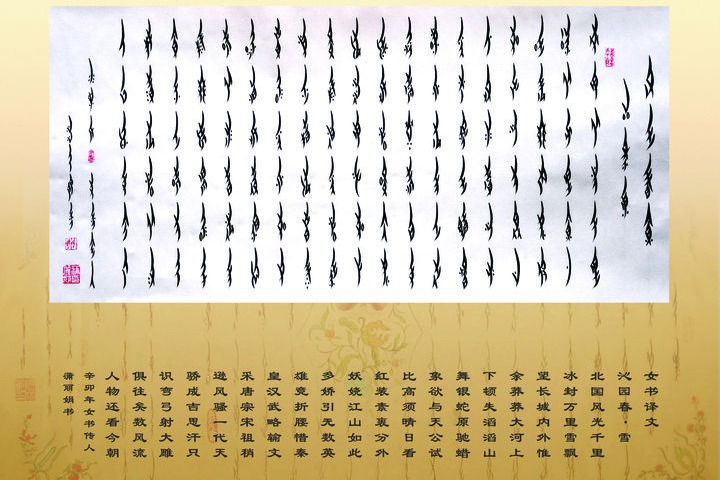
In a remarkable journey spanning over four decades, Professor Zhao Liming of Tsinghua University has dedicated her life to the preservation and study of Nvshu, the world’s only script exclusively created and used by women. Now 78 and retired, Zhao remains as passionate as ever about this unique writing system, which originated in Jiangyong county, Hunan province, during a time when formal education was largely inaccessible to women. Nvshu, characterized by its delicate, slanted strokes of dots and arcs, served as a private medium for women to express their emotions, document their lives, and support one another in a patriarchal society. Zhao first encountered Nvshu in the 1980s while teaching at Tsinghua’s Department of Chinese Language and Literature. Her fascination with the script led her to conduct extensive field research in Jiangyong, often traveling on hard-seat trains and trekking through remote mountainous areas to gather information before the script vanished entirely. Zhao’s work revealed that Nvshu was not related to ethnic scripts like Miao or Yao but was a local variant derived from Mandarin, confined to a small geographical area she termed a ‘script island.’ The urgency of her mission was underscored by the passing of Yi Nianhua, an elder Nvshu inheritor, before Zhao could deliver asthma medication to her. This loss deepened Zhao’s resolve to preserve the script, which was traditionally buried or cremated with its practitioners, leaving little behind for future generations. With support from Tsinghua University and fellow researchers, Zhao published a comprehensive book on Nvshu in 1992 and later developed a digital Nvshu character set, successfully lobbying for its inclusion in the International Unicode Standard in 2015. According to Zhao, Nvshu represents a unique form of ‘Eastern feminism,’ offering women a private outlet for self-expression and emotional support without directly confronting the patriarchal system. Though the era of natural Nvshu transmission ended with the death of its last traditional inheritor in 2004, Zhao believes the script’s legacy endures as a symbol of female resilience and cultural identity. Today, Nvshu has gained global attention and inspired new generations, evolving from a hidden women’s script into a celebrated cultural artifact. ‘Nvshu was like a meteor — it shone brightly and fulfilled its mission,’ Zhao said. ‘Now, women have access to education and can travel freely. Nvshu’s initial purpose may be complete, but its spirit lives on.’ Even in retirement, Zhao continues to study and promote Nvshu, driven by a belief in its beauty and historical significance.