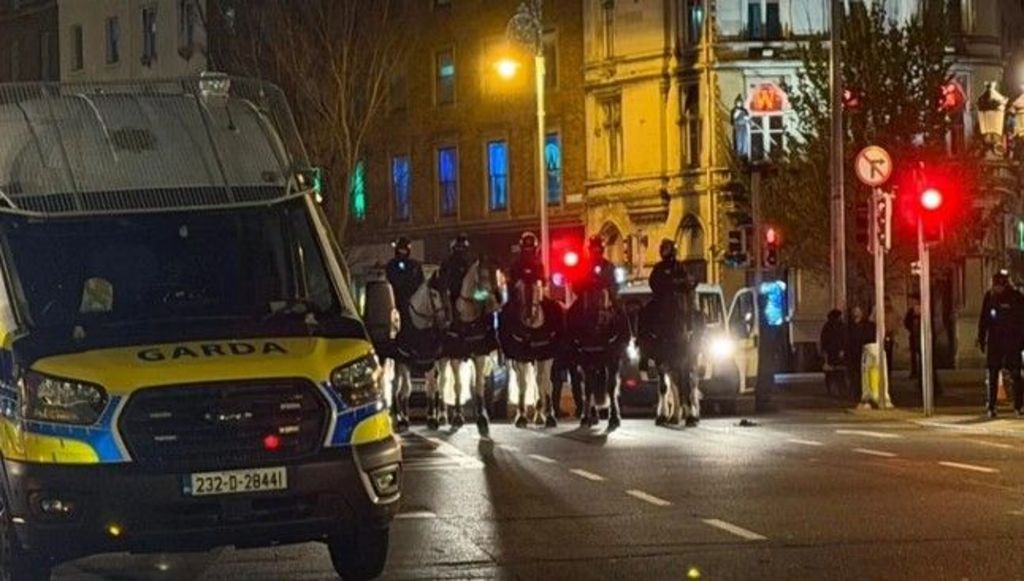
DUBLIN — Six days of widespread anti-fuel price protests that have paralyzed key infrastructure across the Republic of Ireland entered a new phase Sunday, as Irish national police (An Garda Síochána) successfully cleared the main protest encampment on Dublin’s iconic O’Connell Street in an early-morning multi-unit operation.
The demonstrations, led by farmers and hauliers, erupted in response to skyrocketing fuel prices driven by the ongoing conflict between the United States, Israel and Iran, which has disrupted global oil supplies via the closure of the Strait of Hormuz — a chokepoint that carries roughly 20% of the world’s daily oil trade. In recent weeks, diesel prices in Ireland have jumped from an average of €1.70 per litre to €2.17, while petrol has increased by as much as 25 cents per litre at retail forecourts, pushing already strained transport and agricultural sectors to breaking point.
To clear O’Connell Street, Gardaí deployed approximately 200 uniformed officers, supported by the elite public order unit, mounted police on horseback, and a waterborne patrol along the River Liffey, with a police helicopter providing aerial surveillance. Shortly after 3:30 a.m., authorities issued a formal order for demonstrators gathered in tractors and trailers to evacuate the area. All protesters complied with the request and left the site peacefully, with many departing voluntarily ahead of the operation and remaining individuals exiting under Garda escort. As of Sunday morning, a small number of vehicles remained parked on the street, but state broadcaster RTÉ reports most vehicle owners have agreed to move their assets in the coming hours with police cooperation.
Alongside the O’Connell Street clearance, Gardaí also lifted a blockade on the northbound lane of Dublin’s M50 motorway, one of the country’s busiest orbital routes. However, demonstrations continue at other key sites: protesters have erected a new barricade on the access bridge to Galway Port on Ireland’s west coast, and blockades of three major fuel distribution hubs in Cork, Galway and Limerick counties have been in place since the protest movement began Tuesday.
The ongoing blockades have already triggered severe fuel shortages across the country, with hundreds of retail petrol and diesel forecourts reporting they have completely run out of stock. Over the weekend, authorities warned that fuel supplies for critical emergency services, including ambulance fleets and fire brigades, are facing growing strain. The National Emergency Coordination Group, the inter-agency body tasked with managing national crises, confirmed emergency service fuel reserves are under “increasing pressure” amid the ongoing disruptions. Taoiseach Micheál Martin, Ireland’s prime minister, warned Saturday that the blockades have left the country “on the precipice of turning oil away from the country” at a time of already strained global supply.
Progress emerged at one key site Saturday, when fuel trucks regained access to the Whitegate Oil Refinery in County Cork after a days-long blockade. Gardaí pushed back protesting demonstrators using pepper spray during the clearance operation, which received logistical support from the Irish Defence Forces. Garda Commissioner Justin Kelly confirmed that multiple arrests were made during the operation, and issued a firm warning to continuing protesters that blockades are illegal and will not be tolerated.
“We gave these blockaders fair warning that we were moving to an enforcement phase and they chose to ignore that and continue to hold the country to ransom,” Kelly said in a statement released Sunday. The commissioner also confirmed that police have received multiple reports of intimidation against fuel tanker drivers, noting that serious offences including threats of harm carry maximum prison sentences of up to 10 years. “My message is clear: blockaders must immediately cease blockades of critical infrastructure and road networks or face the full rigours of the law,” he added.
Opposition politicians have criticized the government’s handling of the crisis. Mary Lou McDonald, leader of Ireland’s largest opposition party Sinn Féin, said Saturday that the sitting government allowed a localized difficult situation to escalate into a national crisis, and urged officials to accelerate good-faith negotiations with protest leaders to end the disruptions.
Irish government officials have been engaged in talks with protest representatives from the farming and haulage sectors since Friday, focused on finalizing a new government support package to offset rising fuel costs. A full cabinet meeting is scheduled for Sunday to receive an official update on the ongoing crisis negotiations, as authorities work to resolve the standoff and restore normal fuel supply chains across the country.