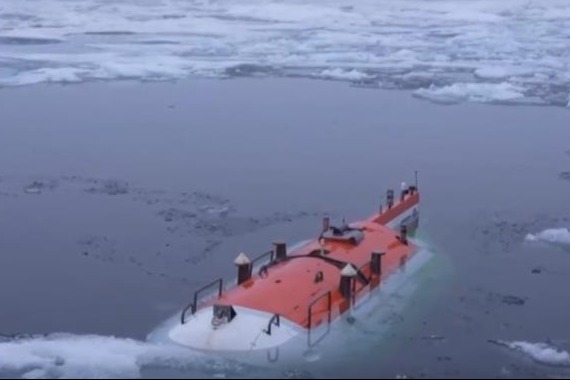
China has successfully concluded its first-ever collaborative deep-sea manned submersible operation, marking a significant milestone in the nation’s polar research capabilities. The mission, which spanned 98 days, primarily focused on the Arctic Circle and was carried out by the Tansuo 3, the world’s first ice-breaking manned deep-sea submersible support vessel. The expedition, jointly organized by the Ministry of Natural Resources and the Chinese Academy of Sciences, utilized China’s domestically developed submersibles, Fendouzhe and Jiaolong. During the mission, the team navigated 1,989 nautical miles through ice-covered waters, conducting 43 dive missions. Notably, Jiaolong and Fendouzhe performed cooperative operations, including dual-submersible positioning searches and underwater motion filming, a first for China. The team also achieved the world’s first manned deep-sea exploration of the Gakkel Ridge, a tectonic plate boundary in the Arctic’s central basin. Fendouzhe completed 32 dives, reaching a maximum depth of 5,277 meters and enduring extreme polar conditions. The mission validated the operational capabilities of Fendouzhe and Tansuo 3 in polar ice-covered regions, establishing new protocols for extreme conditions and pioneering a mobile ice-diving model. This effort has cultivated a specialized polar deep-diving research team, positioning China as the only nation capable of continuous manned submersible operations in Arctic dense ice zones. The expedition collected valuable water, sediment, rock, and biological samples, providing critical scientific support for studying Arctic climate change, geological processes, and polar life evolution.