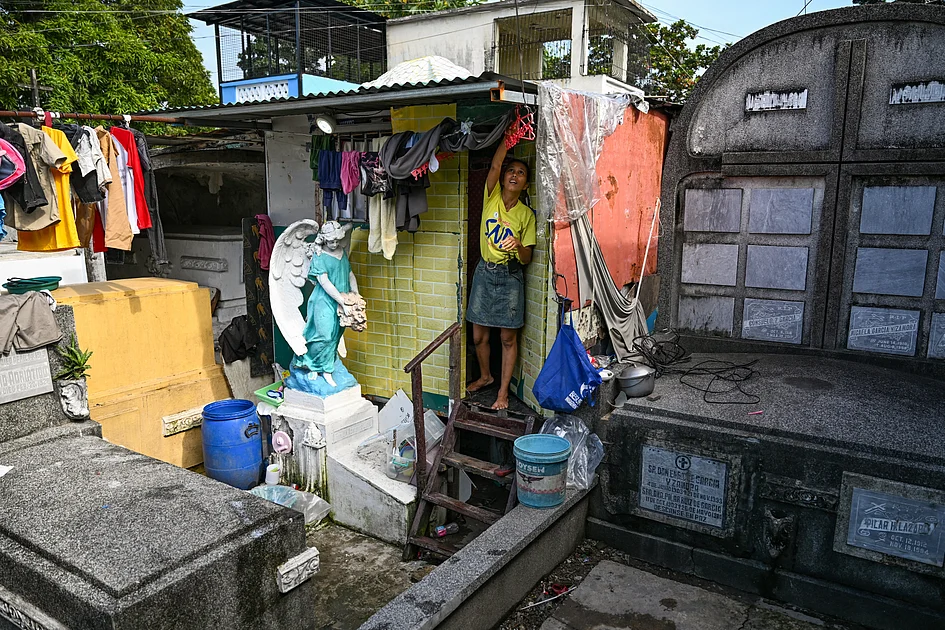
In the heart of Manila, where poverty is pervasive and millions struggle with inadequate housing, some residents have found an unconventional refuge: cemeteries. The Manila North Cemetery, a vast 54-hectare public graveyard, is home to approximately 6,000 informal settlers who live among the tombs of over a million deceased Filipinos. These cemetery dwellers, often referred to as ‘informal settlers,’ have turned the gravesites into makeshift homes, repurposing crypts and mausoleums into living spaces. Laileah Cuetara, a 36-year-old mother of two, resides in a small wooden shanty perched atop a pair of raised tombs. Her home, furnished with a foam mattress, shelves, a television, and picture frames, is a stark reminder of the dire economic conditions faced by many in the Philippines. Cuetara earns around 3,000 pesos ($51) monthly by selling snacks and drinks to cemetery visitors. During All Saints’ Day and All Souls’ Day, she and her partner earn additional income by cleaning and tending to 30 tombs, receiving up to 1,700 pesos for each. However, their earnings are insufficient to escape the cemetery. ‘With the high prices of basic goods nowadays, it’s very difficult to improve our living conditions,’ Cuetara lamented. She moved into the cemetery in 2008 after a family conflict forced her to leave her suburban home. The plight of cemetery dwellers like Cuetara is not unique. Priscilla Buan, 51, was born in the cemetery and has raised her children among the tombs. She and her family sleep atop two crypts in a mausoleum, with the remaining space converted into a living room complete with a sofa, cabinet, and appliances. Buan sells snacks from the tomb’s grilled window but dreams of a better life. ‘Even if I wanted to, we don’t have money to buy a house,’ she said. The number of cemetery dwellers has been increasing, according to Vicente Eliver of the Kapatiran-Kaunlaran Foundation, which provides livelihood and educational programs to these residents. Eliver noted that while only grave caretakers and their families once lived in the cemetery, their descendants have continued the tradition, leading to a growing population. Most residents claim to have permission to occupy mausoleums or build shanties on graves in exchange for maintaining them. They tap into existing power lines for electricity and pay 3 pesos per gallon of water from nearby wells. However, Daniel Tan, the cemetery director, emphasized that the arrangement is not meant to be permanent. ‘This is a cemetery, it’s for the dead and not for the living,’ Tan stated. He acknowledged that the city is attempting to find permanent housing solutions but provided no specifics. For Cuetara and others, living in the cemetery is a last resort. Her 11-year-old son faces bullying at school due to their address, while her six-year-old daughter dreams of a real home, often drawing houses that adorn their makeshift dwelling. ‘All of us here dream of having a house outside, but… it’s hard, very hard,’ Cuetara said.
Photos: Poverty forces these Filipinos to live among the dead, become cemetery dwellers