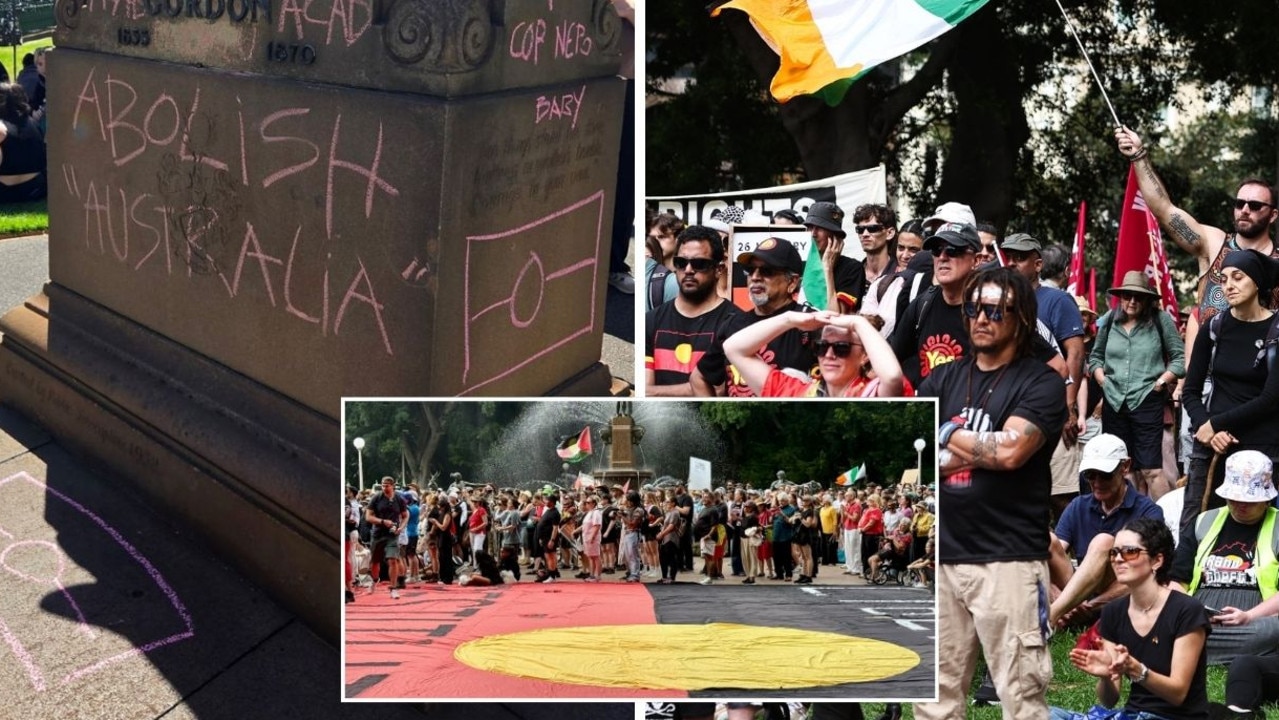
Australia’s national holiday was marked by intense polarization as competing rallies—Invasion Day protests and March for Australia demonstrations—unfolded simultaneously in major capital cities, resulting in controversial scenes and arrests.
In Brisbane, an Australian flag was set ablaze during an Invasion Day gathering at Queens Gardens, while in Melbourne, a statue of poet Adam Lindsay Gordon was defaced with the phrase ‘Abolish Australia.’ Meanwhile, Sydney witnessed crowds chanting ‘send them back’ and displaying placards demanding the release of Joel Davis, a prominent figure in the disbanded National Socialist Network (NSN), who is currently in remand for allegedly inciting violence against MP Allegra Spender.
A 31-year-old man was arrested in NSW during the March for Australia rally for alleged hate speech. Assistant Commissioner Brett McFadden stated that the language used ‘incited hatred towards groups in the community’ and crossed the line from free speech into unlawful conduct. The suspect remains in custody pending further investigation.
Political figures were highly visible at the events. One Nation leader Pauline Hanson addressed supporters in Brisbane, criticizing hate speech laws and mass immigration policies. ‘We can never give up our freedom of speech,’ she declared, blaming Prime Minister Anthony Albanese for current migration levels. In response, Greens Senator Larissa Waters accused Hanson of divisiveness and racism.
Cultural tensions also surfaced around musical representation. March for Australia organizers defiantly played Men at Work’s ‘Down Under’ despite explicit objections from co-writer Colin Hay, who denounced the use of his song for promoting xenophobia. Rally organizer Bec Walker responded with expletives directed at the musician.
Amid the tensions, Invasion Day rallies also featured solemn moments. In Sydney, a minute of silence was observed for Sophie Quinn, John Harris, and Nerida Quinn, who were recently killed in a shooting in Lake Cargelligo. Uncle Robbie Thorpe in Melbourne criticized the recently signed Victorian treaty as ‘disingenuous,’ while Celeste Little called for Australia Day to become a national day of mourning.
Heavy police presence was reported across all cities to manage the opposing demonstrations and prevent clashes.