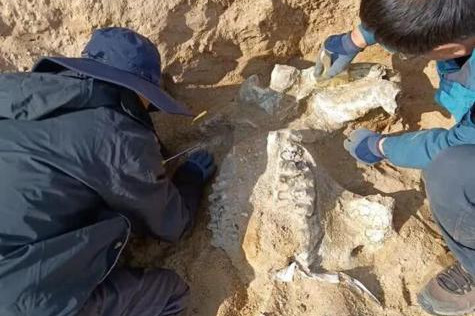
In a significant paleontological discovery, researchers have unearthed a remarkably well-preserved fossil of a tetralophodon—an ancient progenitor of modern elephants—from a retired mining site in Wuzhong, Ningxia Hui Autonomous Region. The specimen, estimated to be approximately 9 to 11 million years old, represents the first completely intact large-mammal fossil recovered in the region over the past decade.
The excavation team, comprising leading paleontologists, conducted meticulous fieldwork at the location, revealing the exceptional preservation of the skeletal remains. Tetralophodons, characterized by their four-ridged molar teeth, inhabited various ecosystems during the Miocene epoch and are considered crucial evolutionary links in understanding proboscidean development.
This discovery provides unprecedented insight into the migration patterns and anatomical evolution of prehistoric elephant species across Asia. The finding’s significance extends beyond mere anatomical preservation, offering researchers valuable data about regional climate conditions and ecological systems that existed millions of years ago in what is now northwest China.
The Ningxia discovery marks a substantial contribution to vertebrate paleontology, potentially reshaping understanding of proboscidean dispersal routes across the Asian continent. Local authorities have implemented enhanced protective measures at the excavation site while scientists continue detailed analysis of the specimen, which may reveal new information about the species’ adaptation mechanisms and eventual extinction.