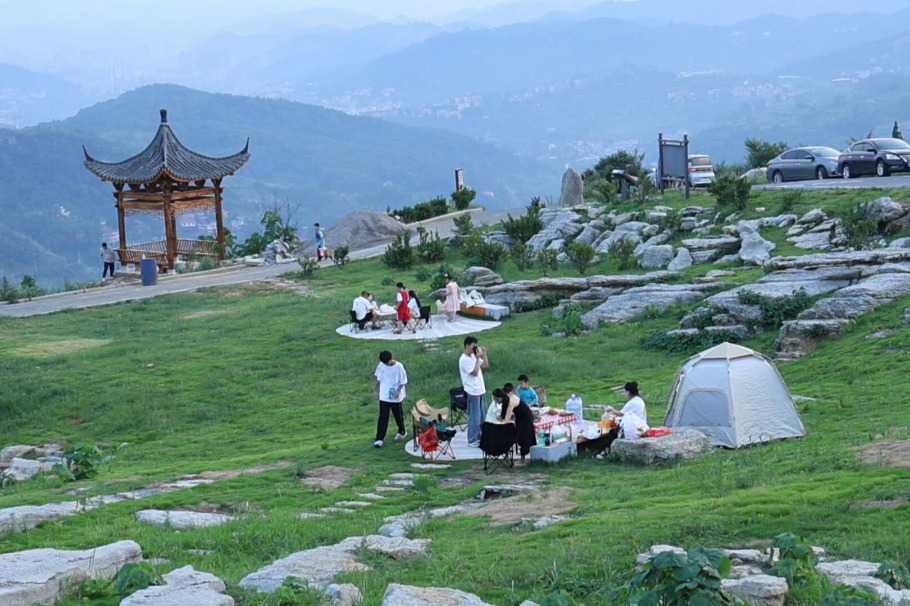
The Xikuangshan mining region in China’s Hunan province has undergone a remarkable ecological transformation, turning from a severely polluted industrial wasteland into a thriving green landscape that now attracts international visitors and academic researchers alike.
For generations, this area in Lengshuijiang county was known as the ‘World Antimony Capital,’ having produced approximately one-third of China’s total antimony output and a quarter of global production over the past century. The industrial legacy came at tremendous environmental cost, with decades of intensive underground mining causing severe vegetation deterioration, air and water pollution, and ground subsidence that forced many residents to relocate.
Eighty-three-year-old Xie Guoxiu, whose family has lived in the core mining area for generations, recalls the toxic conditions that once dominated the landscape. ‘We couldn’t grow vegetables in the yard and had to buy produce from distant urban areas,’ she remembered. ‘The pollution drove many neighbors away.’
The turnaround began in 2006 when the Lengshuijiang city government launched a comprehensive environmental campaign. Early efforts focused on relocating residents from subsidence-affected areas, dredging polluted rivers, and building alternative water supply systems. The project gained significant momentum in 2013 when it was included in Hunan province’s ‘No. 1 Project’—a key initiative for comprehensive pollution treatment along the Xiangjiang River.
Between 2018 and 2021, authorities invested over 300 million yuan ($42.6 million) in ecosystem restoration, successfully reviving 187 hectares of forest and 160 hectares of farmland. Today, abandoned mining sites have been replaced by photovoltaic power stations and wind farms, while once-denuded hills now feature lush forests, grasslands, and productive farmland.
The area’s dramatic transformation has earned international recognition, including being showcased at the UN Convention on Biological Diversity (COP15) in 2021 as one of China’s typical ecological restoration cases. Earlier this year, Xikuangshan was selected as one of 20 exemplary cases under the UN Decade on Ecosystem Restoration, a global initiative jointly led by the UN Environment Programme and the Food and Agriculture Organization.
The restored area now serves as a geological fieldwork base for students and researchers from numerous higher education institutions. According to Yi Shengxing, chief engineer at the Lengshuijiang Natural Resources Bureau, the project has evolved beyond pollution treatment to create a sustainable development model combining ecology, culture, and tourism.
The success in Xikuangshan reflects broader progress across Hunan province, where officials have restored 9,298 hectares of historical mining sites—far exceeding the 14th Five-Year Plan target of 6,000 hectares. The region’s revival demonstrates how former industrial centers can successfully transition toward environmentally sustainable and economically viable futures.