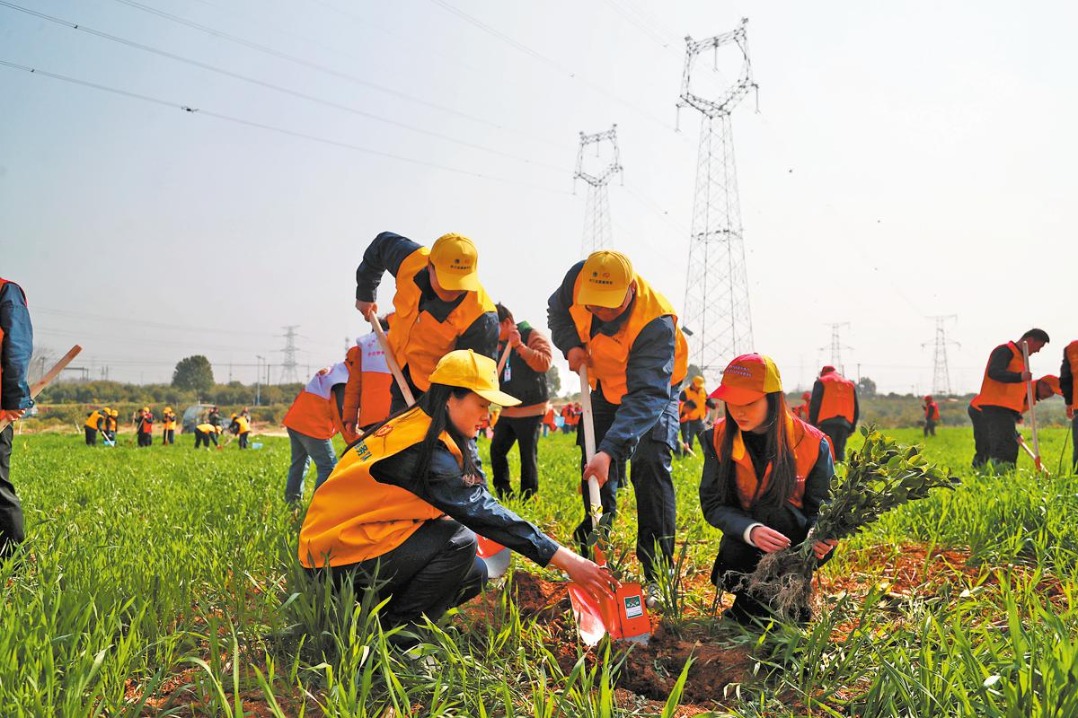
In a groundbreaking initiative merging infrastructure security with agricultural development, rows of oil-tea camellia seedlings now flourish beneath high-voltage transmission lines on the outskirts of Wuhan, Hubei province. This innovative approach, pioneered by the Wuhan branch of State Grid, represents a fundamental shift in how power transmission corridors are managed nationwide.
The transformation began when Siwugang Village Party Secretary Cheng Xinggan received 1,200 oil-tea saplings shortly after the Chinese New Year. ‘There’s no better gift than seedlings,’ Cheng remarked, highlighting the dual significance of the donation for both grid protection and economic development. The planting ceremony, timed with China’s Arbor Day observances, brought together villagers and volunteers to establish what may become a model for similar projects across the country.
Historically, vegetation management beneath power lines focused exclusively on clearance to prevent electrical hazards. Pan Zhongyu, head of a local power supply station, explained the paradigm shift: ‘We used to focus on stopping trees from growing under the lines. Now we plant trees, but we do it scientifically and safely.’
After extensive research, State Grid specialists identified oil-tea camellia as the ideal species for these environments. The trees exhibit slow growth patterns, typically reaching only 2-3 meters in height, and respond well to pruning that maintains them safely below the 10-meter clearance required for transmission lines. Beyond safety considerations, the plantations provide significant environmental benefits including soil stabilization and erosion prevention.
The economic implications are substantial for rural communities. As one of the world’s major woody oil crops, oil-tea camellia produces cold-pressed tea oil with consistent market demand. Cheng estimates that the 1.07-hectare plantation containing approximately 1,200 trees will reach full production within three years, generating nearly 100,000 yuan (approximately $14,558) in annual revenue for the village.
Each seedling now bears a small tag with safety reminders and environmental messages, symbolizing the integration of technical requirements with ecological consciousness. According to Xu Bin of the Hubei Volunteer Association, the project demonstrates how critical infrastructure protection and rural development can advance together harmoniously.
‘Planting suitable crops under power lines improves the environment, increases farmers’ income and protects the grid,’ Xu noted, capturing the multifaceted benefits of this innovative approach to land use management beneath critical energy infrastructure.