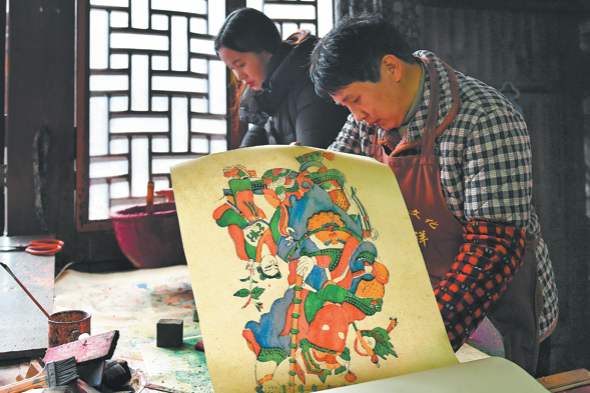
As China enters layue, the twelfth lunar month, the picturesque town of Tantou in Hunan province comes alive with the centuries-old tradition of creating vibrant nianhua (New Year paintings). These elaborate artworks transform ordinary doors into canvases depicting fortune gods, striped tigers, and whimsical scenes like mouse wedding processions, serving as both cultural expressions and talismans believed to ward off misfortune while inviting prosperity.
Tantou nianhua boasts a remarkable history spanning over three centuries, earning the town the prestigious title “Hometown of Modern Folk New Year Paintings.” The tradition gained national recognition when renowned writer Lu Xun nostalgically described a Tantou “mouse wedding” painting that adorned his childhood bedroom in his essay collection Dawn Blossoms Plucked at Dusk.
The creation process represents a completely self-contained local production cycle rare in Chinese folk art. Artisans begin by crafting specialized paper from locally sourced bamboo, providing the perfect textured base for printing. The heart of the technique lies in woodblock carving using the distinctive “steep knife upright line” method, which requires exceptional precision and artistic intuition to maintain consistent angles and pressure throughout intricate designs.
National intangible cultural heritage inheritor Liu Guoli emphasizes the spiritual dimension of the craft: “Your personality and temperament shape the carving, making each block unique.” The vibrant coloration emerges through a multi-step printing process where each hue corresponds to a separate woodblock, culminating in hand-painted facial features that imbue characters with lifelike qualities.
The artworks’ striking palette features tangerine reds, brilliant yellows, rose pinks contrasted with cool cyan and deep charcoal—a dynamic interplay that gives each piece its characteristic vitality. Professor Wu Yuqing of Hunan Normal University’s Fine Arts Academy notes: “The motifs represent a practical aesthetic shaped over centuries by countless families. The more deeply art is rooted in ordinary people’s lives, the more vibrantly its brilliance unfolds.
Recent documentation in the series Ancient Crafts of Hunan employed macro lenses and slow-motion cinematography to showcase this intricate process, bringing renewed attention to Tantou’s cultural treasure that was among China’s first entries on the national intangible cultural heritage list in 2006.