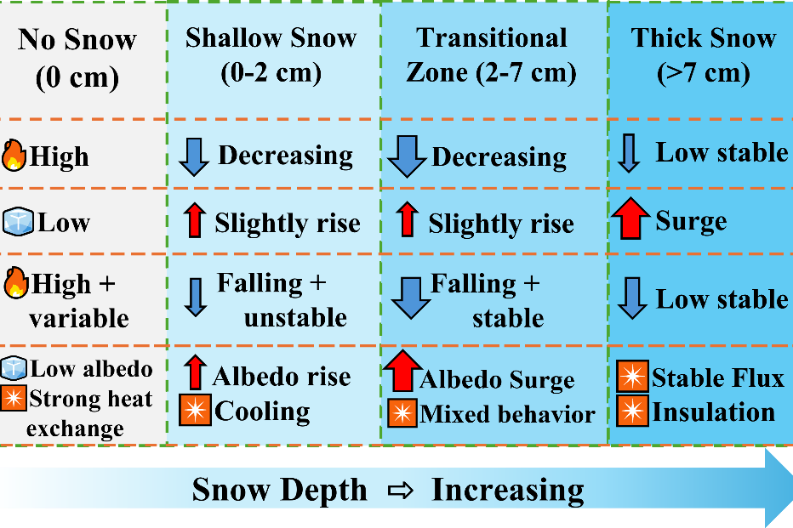
A pioneering study conducted by Chinese scientists has uncovered the intricate coupling effects between snow cover and ground thermal dynamics on the Qinghai-Tibet Plateau. Published in the journal *Agricultural and Forest Meteorology*, the research was jointly carried out by the Northwest Institute of Eco-Environment and Resources (NIEER) under the Chinese Academy of Sciences and the Nanjing University of Information Science and Technology (NUIST). The study integrates snow cover processes into land surface and climate models for cold regions, significantly enhancing the accuracy of permafrost evolution predictions and extreme event risk assessments. The Qinghai-Tibet Plateau, home to the world’s largest high-altitude permafrost zone, has experienced accelerated warming due to global climate change. Unlike the Arctic, the plateau’s snow cover is typically thin and short-lived, yet it plays a critical role in influencing ground thermal regimes and surface energy fluxes. Researchers conducted years of in-situ observations at two alpine permafrost sites, located at 5,100 meters and 4,538 meters above sea level, respectively. They analyzed snow cover characteristics, ground surface temperature responses, and energy flux dynamics. The team also proposed a ‘four-interval mechanism framework’ to describe the evolutionary stages of snow-ground coupling. According to Hu Guojie, a researcher at NIEER, this framework provides operational criteria and parametric insights for shallow snow-dominated areas. Professor Zhao Lin from NUIST emphasized that the study quantified the nonlinear thermal effects of shallow snow cover on alpine permafrost, offering observational evidence and conceptual benchmarks for developing threshold-sensitive snow-ground coupling schemes in climate models.