A groundbreaking study led by researchers from the Chinese Academy of Sciences has revolutionized refrigeration technology by developing a novel cooling method that simultaneously achieves zero emissions, high cooling capacity, and exceptional heat transfer efficiency. Published in the prestigious journal Nature, this research addresses critical environmental and energy challenges posed by conventional cooling systems.
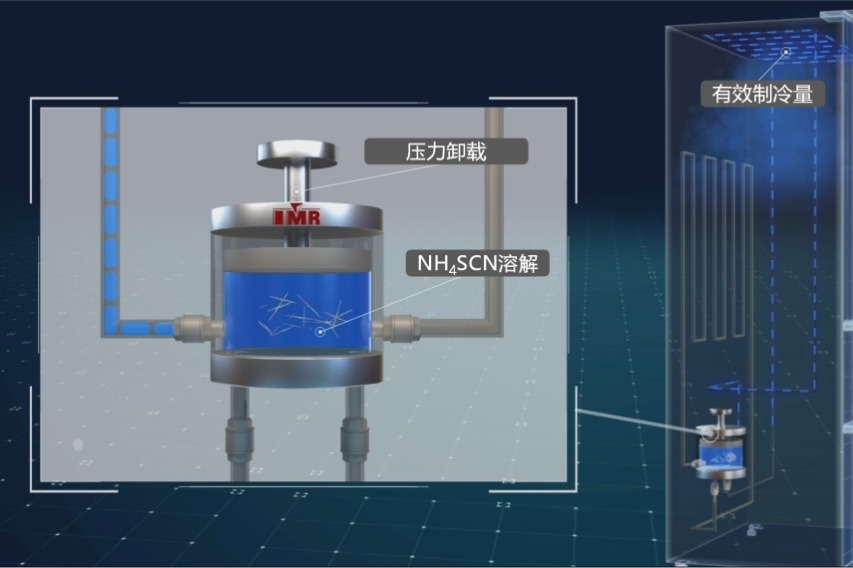
The research team, under the leadership of Professor Li Bing from the Institute of Metal Research, discovered an innovative approach that integrates solid cooling effects with liquid flow dynamics. Their investigation focused on ammonium thiocyanate, a non-toxic industrial salt that demonstrates remarkable thermal properties when dissolved in water. The team observed that the salt’s dissolution absorbs substantial heat, while applying pressure reverses the process, causing precipitation and heat release. This reversible cycle creates a continuous cooling mechanism ideal for refrigeration applications.
Unlike traditional vapor-compression systems that account for approximately 20% of China’s electricity consumption and 7.8% of carbon emissions, this new technology eliminates the need for environmentally harmful fluorocarbon refrigerants. Professor Li explained that their method transcends conventional limitations by combining refrigerant and heat-transfer medium into a single fluid, effectively solving what scientists previously termed the ‘impossible triangle’ of caloric materials.
Laboratory results demonstrated exceptional performance, with temperature drops of nearly 30°C achieved within 20 seconds at room temperature and cooling spans reaching 54°C at elevated temperatures. The prototype system showed a cooling capacity of 67 joules per gram with efficiency approaching 77%, while in-situ spectroscopic experiments confirmed the process’s stability, reversibility, and instantaneous response to pressure changes.
The technology’s superior high-temperature performance positions it as an ideal solution for thermal management in next-generation artificial intelligence computing centers, where heat dissipation presents significant challenges. While the research shows tremendous promise for industrial and domestic refrigeration applications, the team acknowledges that further engineering breakthroughs are needed to optimize rapid and reversible pressure-tuned phase transitions for commercial implementation.