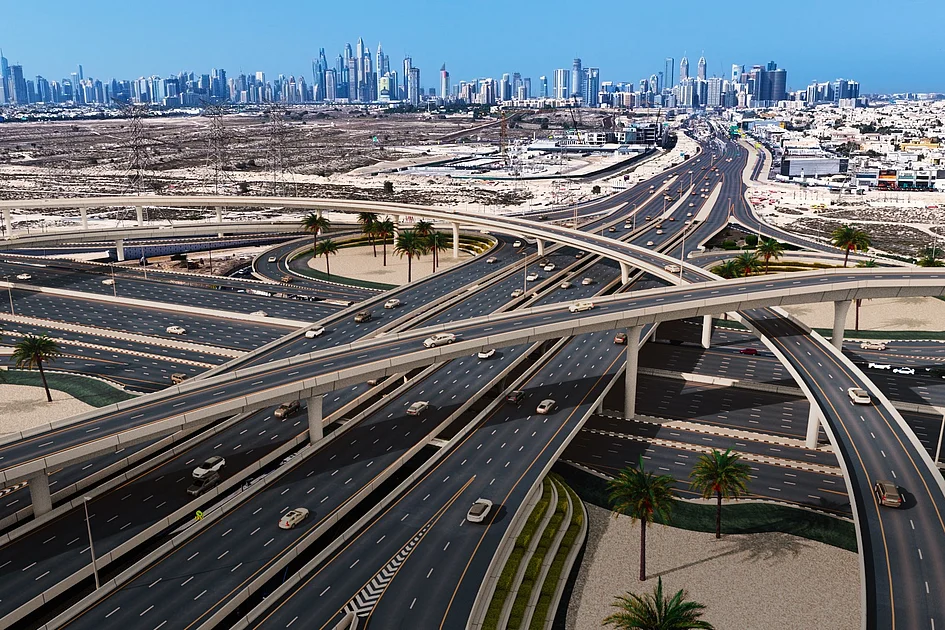
Dubai’s Roads and Transport Authority (RTA) has initiated a transformative infrastructure project that will dramatically reduce travel times along Hessa Street, cutting a typical 24-minute journey to just five minutes. The ambitious development, currently in its second phase, spans the crucial 3-kilometer corridor between Al Khail Road and Sheikh Mohammed bin Zayed Road, serving as a vital artery for urban mobility.
The comprehensive upgrade involves sophisticated engineering solutions including the construction of 8,835 meters of bridges and a 480-meter tunnel, significantly enhancing three major intersections. The project will double Hessa Street’s capacity from 4,000 to 8,000 vehicles per hour, directly benefiting approximately 650,000 residents across ten residential and development areas including Al Barsha South, Arjan, Dubai Science Park, and Motor City.
Phase two specifications include expanding Hessa Street from two to four lanes in each direction, constructing grade-separated collector roads, and implementing multiple directional ramps to optimize traffic flow. A notable 2,215-meter bridge system will accommodate 18,200 vehicles hourly, while a 525-meter braided ramp will eliminate congestion points between Al Khail Road and Al Khamila Street.
Concurrently, Phase one developments nearing April completion feature upgraded intersections at Sheikh Zayed Road, First Al Khail Street, Al Asayel Street, and Al Khail Road. This initial phase already delivered a 1,000-meter bridge enabling travel time reduction from 15 to 3 minutes between key corridors, alongside a 13.5-kilometer cycling track integrating with Dubai Internet City Metro Station.
The project incorporates sustainable mobility solutions through a 10.4-kilometer dedicated cycling and e-scooter track connecting Dubai Hills and Dubai Motor City. This infrastructure includes two architecturally distinctive bridges spanning Sheikh Zayed Road and Al Khail Road, each featuring segregated lanes for cyclists and pedestrians with capacity for 5,200 users hourly.
Additional enhancements involve converting all existing roundabouts to signalized intersections, widening Al Hadaeq Street to dual carriageway with three lanes each direction, and implementing comprehensive traffic management systems throughout the corridor. The development represents Dubai’s continued commitment to cutting-edge urban planning and multimodal transportation integration.