A groundbreaking archaeological discovery at Brusselstown Ring in Ireland’s Wicklow Mountains is fundamentally reshaping our understanding of ancient settlement patterns in prehistoric Britain and Ireland. Research led by Dr. Dirk Brandherm from Queen’s University Belfast has revealed what appears to be the largest nucleated settlement ever documented from prehistoric times in the region, dating back approximately 3,200 years to the Late Bronze Age.
The extensive survey work, utilizing advanced aerial photogrammetry and mapping techniques, has identified more than 600 suspected house platforms within the massive hilltop enclosure. This settlement complex spans multiple hilltops—a rare feature among European hillforts—with defensive ramparts encircling both Brusselstown’s summit and the adjacent Spinas Hill. The distribution shows 98 structures within the inner enclosure and over 500 located between the dual defensive walls.
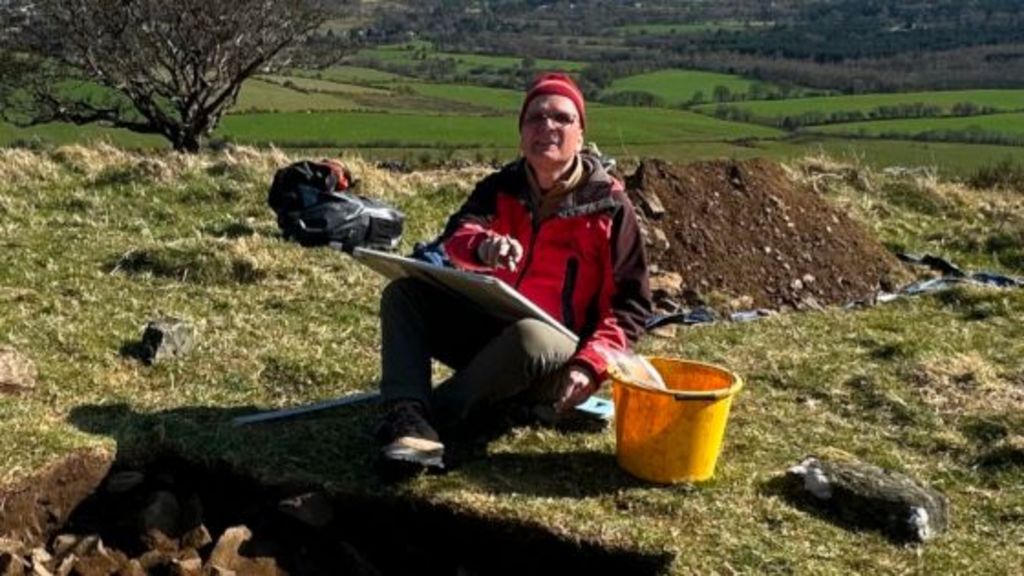
Recent test excavations conducted between August and September 2024 by a team including PhD researcher Cherie Edwards and Dr. Linda Boutoille have provided critical insights into the settlement’s chronology and complexity. The evidence indicates primary occupation during the Late Bronze Age, with some structures showing continued use into the Early Iron Age. The discovery of a sophisticated stone-lined, boat-shaped chamber—potentially a water cistern fed by an uphill stream—adds another layer of architectural sophistication to the site.
The scale and density of Brusselstown Ring challenge previous archaeological assumptions that Bronze Age settlements consisted primarily of small hamlets with one to five dwellings. This discovery dwarfs the previously largest known settlement at Corrstown, Northern Ireland, which contained approximately 74 roundhouses. The presence of structures of varying sizes (4-12 meters in diameter) suggests possible social or economic stratification, though further analysis is required to confirm this hypothesis.
Published in the peer-reviewed journal Antiquity, these findings potentially rewrite the urban history of Ireland, suggesting the existence of proto-urban settlements some 2,000 years before Viking influence in the region. Future research will focus on confirming the cistern’s function and dating, detailed analysis of roundhouse structures, and establishing a comprehensive chronology of the enclosure elements.