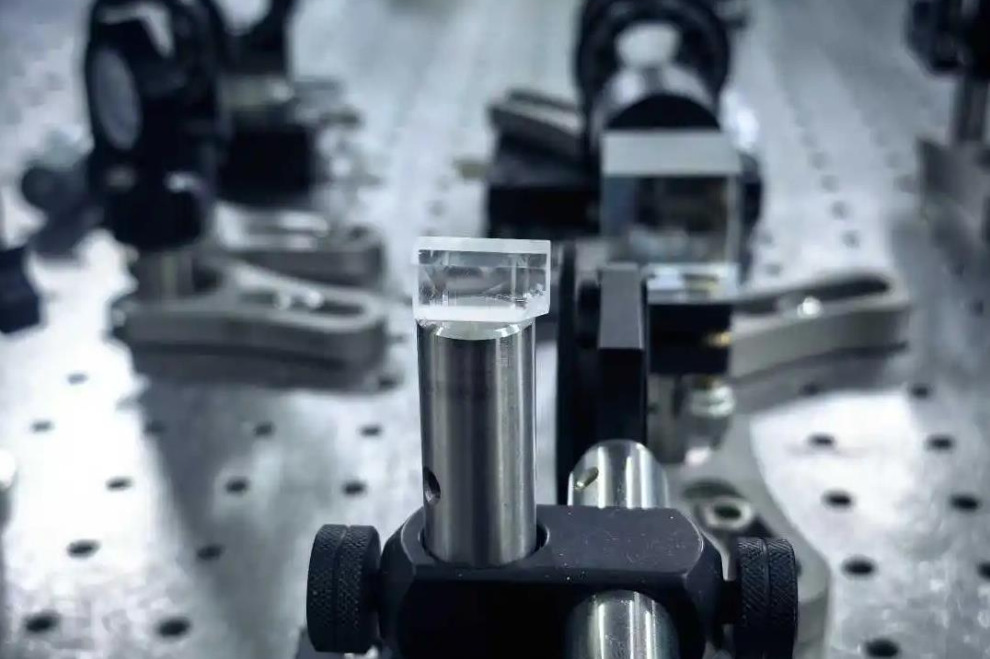
Chinese scientists have achieved a groundbreaking advancement in laser technology with the development of a novel crystal capable of producing vacuum ultraviolet lasers at unprecedented wavelengths. The research team, led by Director Pan Shilie from the Xinjiang Technical Institute of Physics and Chemistry, has successfully created ammonium fluorooxoborate (ABF) crystals that generate lasers at a record-breaking 158.9 nanometers, pushing the boundaries of precision technology.
This scientific milestone, detailed in a recent publication in Nature, represents the culmination of over a decade of dedicated research to overcome significant material science challenges. The team’s persistence has yielded centimeter-sized ABF crystals that demonstrate exceptional durability, stability, and performance characteristics essential for industrial applications.
The technological implications extend across multiple high-precision industries. In semiconductor manufacturing, these advanced lasers will enable the creation of finer circuit patterns critical for next-generation computing chips. The aerospace sector stands to benefit from ultra-precise surface treatments for satellite components, while medical device manufacturers can achieve new levels of precision in surgical implant production.
Beyond industrial applications, the breakthrough holds promise for fundamental scientific research. The vacuum ultraviolet lasers produced by ABF crystals may provide researchers with new tools to investigate quantum phenomena and superconductivity mechanisms that have previously remained elusive.
China’s achievement in developing ABF crystals reinforces the nation’s strategic position in advanced materials science. The Xinjiang institute is now progressing toward large-scale production capabilities, with future efforts focused on integrating these superior crystals into compact, cost-effective laser systems for global industrial deployment.