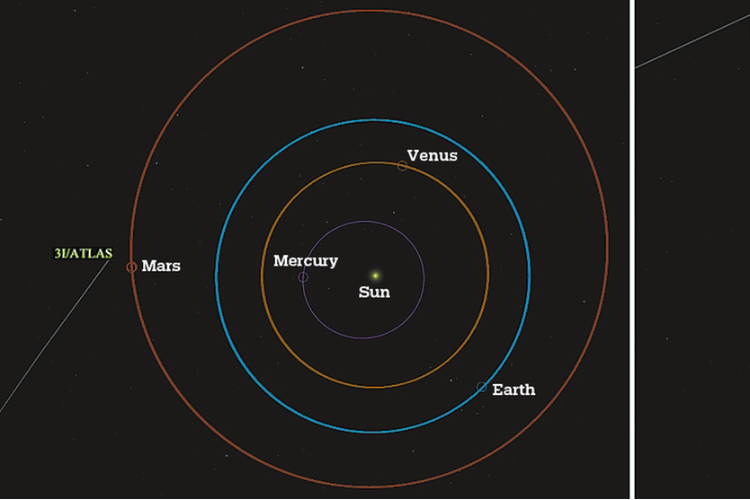
In a groundbreaking achievement, China’s Mars orbiter, part of the Tianwen 1 mission, has successfully captured images of a rare interstellar comet, 3I/ATLAS, as it traversed the solar system. The China National Space Administration (CNSA) announced the milestone on Thursday, marking a significant advancement in space exploration. The comet, first discovered on July 1 by NASA-funded ATLAS telescopes, is the third confirmed interstellar object to pass through our solar system, following 1I/’Oumuamua and 2I/Borisov. The Tianwen 1 orbiter, positioned approximately 29 million kilometers from the comet, executed one of the closest observations of such a celestial body. Scientists and engineers meticulously planned the observation, conducting extensive calculations and simulations to optimize the imaging process. The comet, estimated to be between 3 to 11 billion years old, offers invaluable insights into the composition and evolution of exoplanets. Its unique characteristics, including a tail direction opposite to typical comets, have piqued scientific interest, providing a rare opportunity to study extraterrestrial icy objects. This observation also serves as a technical test for the upcoming Tianwen 2 asteroid exploration mission, launched in May. The discovery underscores China’s growing prowess in space exploration and its contribution to understanding the cosmos.