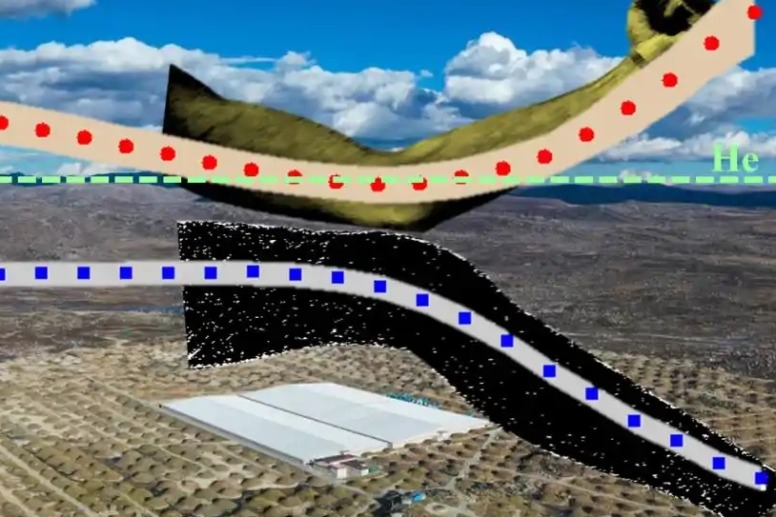
A groundbreaking discovery by Chinese and international scientists has shed light on the enigmatic ‘knee’ structure in the energy spectrum of cosmic rays. This phenomenon, characterized by a sharp decline in particle numbers at higher energies, has puzzled researchers for over seven decades. The breakthrough came through data from China’s Large High Altitude Air Shower Observatory (LHAASO), which identified powerful jets from black holes as the source of ultra-high-energy gamma rays in five ‘microquasar’ systems. These findings, published in the journals National Science Review and Science Bulletin, reveal that cosmic rays from these sources can reach energies exceeding 10 peta-electronvolts, surpassing the ‘knee’ threshold. The research, conducted by teams from the Institute of High Energy Physics of the Chinese Academy of Sciences, Nanjing University, the University of Science and Technology of China, and Italy’s Sapienza University of Rome, marks a significant advancement in understanding cosmic ray origins. LHAASO’s multi-parameter measurement capabilities enabled the collection of high-purity proton samples, allowing for unprecedented precision in mapping the proton energy spectrum. The discovery of a distinct ‘high-energy component’ suggests the existence of multiple cosmic accelerators in the Milky Way, each with unique energy limits. Cao Zhen, LHAASO’s chief scientist, emphasized the importance of continued observations to identify more sources and study the energy spectra of different cosmic-ray nuclei. This research not only deepens our understanding of black hole systems as natural accelerators but also holds potential for improving the design of future man-made particle accelerators. Located in Daocheng county, Sichuan province, LHAASO has become a global leader in cosmic ray research since its operation began in July 2019, reshaping scientific understanding of extreme cosmic processes.