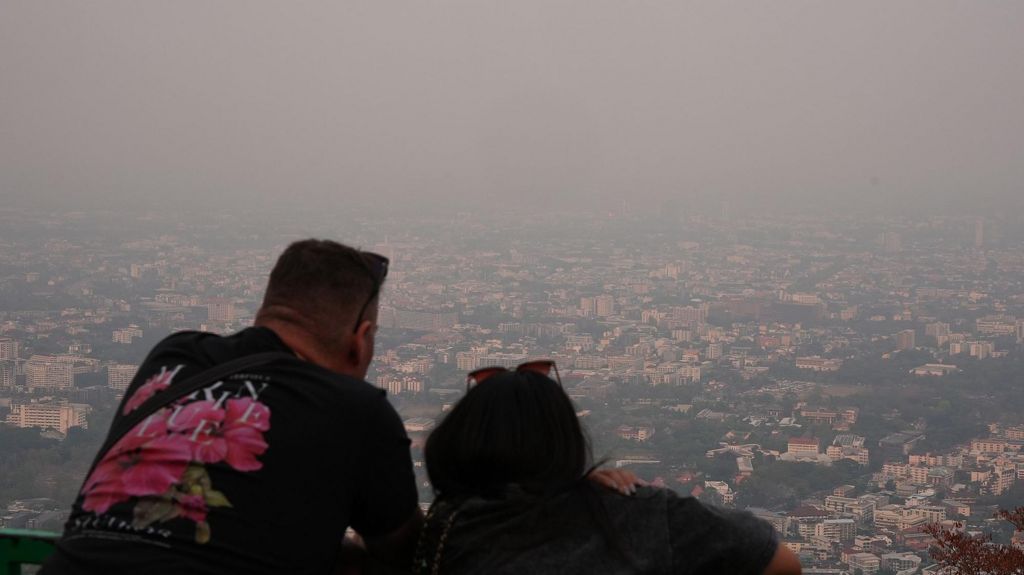
Once celebrated for its misty mountain vistas, crisp cool air and lush tropical landscapes, Chiang Mai in northern Thailand has now become a city gripped by a recurring public health crisis. Decades of unaddressed seasonal air pollution have pushed long-time residents to the breaking point, with many families weighing permanent departure to protect their children’s health.
Tirayut Wongsantisuk, a 41-year-old father, never imagined he would leave the city he and his wife chose for its idyllic natural setting when they relocated in the 2010s. Today, that dream has turned into a daily nightmare: two of his young daughters suffer from frequent nosebleeds, and his six-year-old eldest has developed painful skin rashes and swollen, allergy-ridden eyelids. The persistent poor air quality has left Tirayut with no good options. “I’ve been thinking, maybe we really should move during this season… because if something irreversible happens to our child, we’ll feel terrible forever,” he told the BBC in an on-the-ground interview.
Tirayut’s fear is shared by dozens of other Chiang Mai families caught in this year’s particularly severe fire season. Over the past week, smoke from hundreds of raging blazes has choked the entire northern region, pushing Chiang Mai to the top of IQAir’s global ranking of the world’s most polluted major cities. When a BBC reporting team visited the area last week, a thick, acrid blanket of haze erased the iconic mountain views that draw millions of tourists each year, and a constant smell of burning hung in the air.
Official satellite data underscores the scale of the crisis: on April 1 alone, the system detected 4,750 active fire hotspots across Thailand, a new record, with the vast majority concentrated in the forested and agricultural lands of the north. By the following morning, Chiang Mai’s average PM2.5 concentration — the tiny toxic particles that penetrate deep into the lungs and bloodstream — was rated “very unhealthy” by global public health standards.
The annual crisis runs from November to March, a window that aligns with common agricultural practice: many smallholder farmers burn residual crop stubble to clear fields ahead of planting new season seeds. Dry seasonal conditions also fan the spread of spontaneous wildfires across parched forest and grassland areas. Local media has shared dramatic imagery of mountain slopes entirely engulfed in flames, with some residents comparing the blazing lines of fire to erupting volcanoes.
To curb the spread of blazes, Thai authorities have already implemented emergency measures: all high-fire-risk national parks have been closed to the public, and officials have announced that anyone caught intentionally starting fires in restricted zones will be arrested on site. Under current Thai law, those convicted of illegal forest burning face maximum penalties of 20 years in prison and fines of up to 2 million baht, equivalent to roughly $61,100. Even so, the strict penalties have failed to deter the annual burning that drives the haze crisis.
Public health experts warn that long-term exposure to PM2.5 haze causes a cascade of health complications, ranging from mild issues like itchy eyes and frequent nosebleeds to life-threatening conditions such as respiratory failure and heart attacks. For Benjamas Jaiparkan, a 35-year-old public school teacher in Chiang Mai, the risk is too great to ignore. She has already sent her two children to stay with relatives in neighboring Phayao province, where air quality remains far better than in Chiang Mai, and is now planning a permanent move. Her four-year-old son began experiencing regular nosebleeds last year, and she fears permanent damage to his developing lungs. “I feel so sorry for him because I don’t know how much more his lungs can take,” she said.
Frustration with government inaction has been building for years among Chiang Mai residents. Activists and affected communities have repeatedly filed legal action to force systemic change. In July 2023, more than 1,700 Chiang Mai residents brought a lawsuit against former Prime Minister Prayut Chan-o-cha and two leading state agencies, arguing that the government’s failure to curb northern air pollution had cut an average of five years off each resident’s life expectancy. In January 2024, a Chiang Mai court ruled in favor of the plaintiffs, ordering the national government to draft a binding emergency action plan to improve air quality within 90 days.
The crisis is not isolated to Thailand: hazardous seasonal haze has become a regional public health emergency across Southeast Asia. This year, Malaysia and Indonesia have both recorded their highest number of fire hotspots in seven years, spreading poor air quality across borders and affecting millions of people across the region.