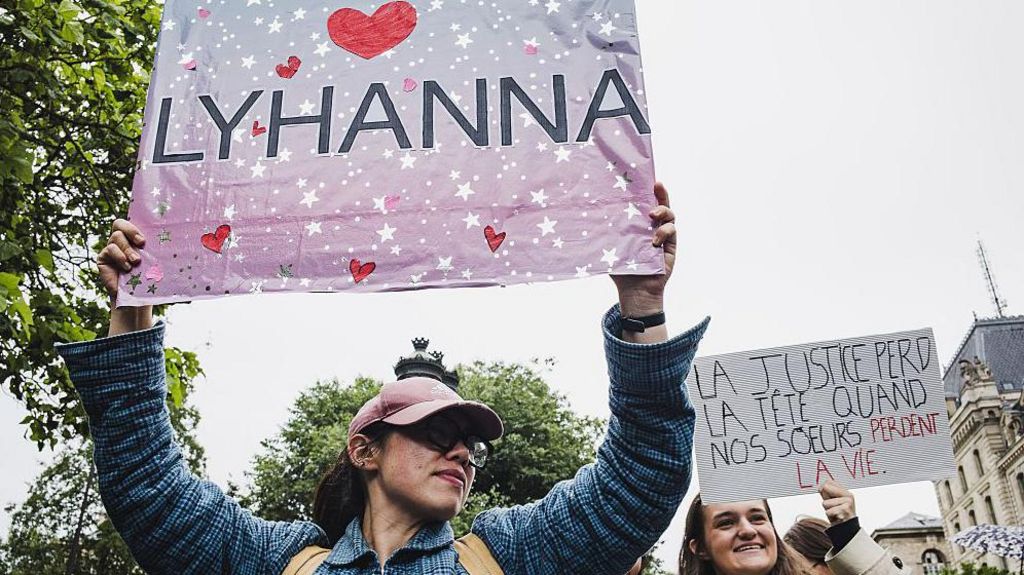
A wave of national outrage has swept across France after the brutal murder of 11-year-old Lyhanna, a case that has exposed catastrophic failures in the country’s justice system and left President Emmanuel Macron’s government grappling with unprecedented political pressure. More than 60,000 protesters marched in cities across the nation on Monday, demanding the resignation of top government official Justice Minister Gérald Darmanin over systemic missteps that many believe directly contributed to the young girl’s senseless death.
The accused killer, 41-year-old Jérome Barella, who is the father of one of Lyhanna’s friends, had been repeatedly reported to French law enforcement as a suspected sex offender long before Lyhanna’s disappearance. The first formal complaint was lodged in August of last year by the mother of 10-year-old Rosa, who claimed Barella had sexually abused her daughter on multiple occasions. Medical examinations confirmed the abuse had occurred, yet in the nine months that followed the filing of that complaint, investigating authorities never once summoned Barella for questioning.
Lyhanna was last seen leaving her school in southwestern France six days before her body was discovered last Thursday on a rural farm roughly 10 kilometers from her hometown of Fleurance. Barella was taken into police custody three days after Lyhanna went missing. While he has denied any involvement in the child’s death, he admitted to driving her to a local swimming pool on the day she disappeared, and has since exercised his right to remain silent when questioned by an investigating judge. Further investigations have revealed that Barella was named as a suspect in multiple other alleged sexual abuse cases in recent years, a red flag that legally should have elevated the Rosa complaint to high-priority status — a step that was never taken.
For the vast majority of the angry French public, the conclusion is clear: if investigators had even contacted Barella after the initial abuse complaint, he would have known he was under surveillance, and Lyhanna’s murder would almost certainly have been prevented. In response to the public fury, Rosa’s mother has announced through her legal team that she is filing a civil lawsuit against the French state and against Darmanin personally, holding both accountable for their roles in the systemic failures that led to the tragedy.
Darmanin, a senior leader of Macron’s ruling Renaissance party, has publicly acknowledged that the Lyhanna case exposed “shocking and unacceptable failings in the services of the state,” but has rejected all calls to step down from his post. The minister and the broader government are now caught between a rapidly radicalizing public and the country’s judicial establishment, which has pushed back hard against attempts to frame magistrates as the sole scapegoats for the failure.
The Higher Magistrature Council (CSM), France’s top judicial oversight body, issued a statement deploring that thousands of hardworking magistrates were being unfairly discredited by the affair, claiming the case was being “instrumentalised by people who have decided in advance that magistrates are the guilty parties.” The CSM also argued that French magistrates, who lead criminal investigations in the country’s justice system, have long been starved of the funding and staffing needed to properly process the huge volume of pending cases.
Darmanin pushed back against that claim during testimony before a Senate committee on Tuesday, asserting that a lack of resources was not the root cause of the failure in the Lyhanna case. “What is missing in this story is not a new law; it’s not more money; it’s not better IT. It’s the need to prioritise allegations of rape,” Darmanin told lawmakers. “The principle of precaution should have been applied to take Mr Barella out of circulation and determine whether the allegations against him were true. We had all the elements. Nine months later it is quite incomprehensible that he was never taken into custody.”
In the wake of the tragedy, Darmanin has ordered state prosecutors to immediately review an estimated 70,000 unresolved sexual abuse complaints involving minor victims that are currently backlogged in the French system. Prime Minister Sébastien Lecornu has also announced plans to toughen pending child protection legislation currently moving through parliament, which would increase the maximum penalty for serial child rapists from 20 years in prison to a potential life sentence. As the nation mourns Lyhanna, demands for sweeping reform of France’s troubled justice system continue to grow, with no clear end to the political standoff in sight.