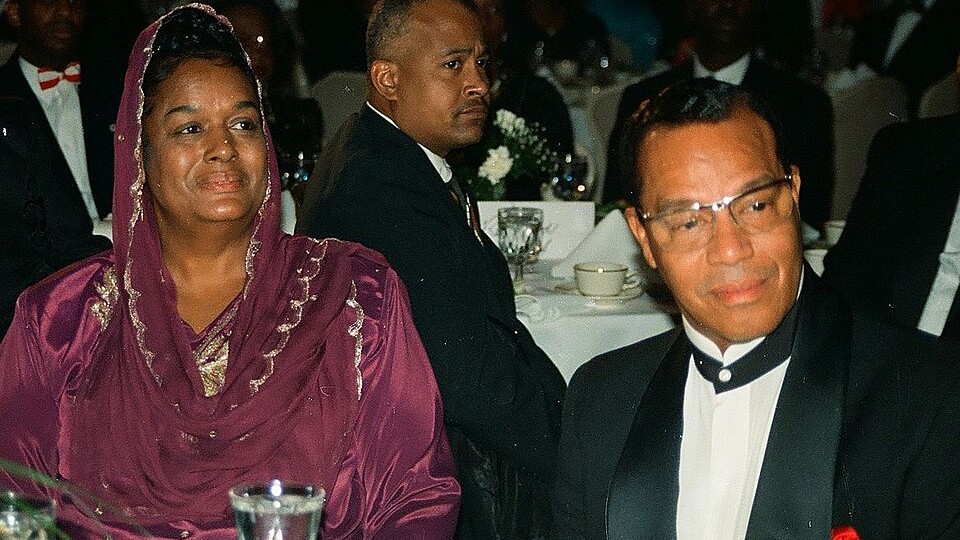
The Nation of Islam, one of the most influential Black religious and political movements in the United States, is mourning the passing of Khadijah Farrakhan, the long-time wife of the organization’s leader Louis Farrakhan. She died on June 27 at the age of 90, leaving behind a 70-plus-year legacy of service to the movement’s mission of Black self-reliance.
Affectionately known to followers as “Mother Khadijah,” she was far more than the spouse of the Nation’s leader — she was a foundational figure in the movement’s modern history. A formal statement released by the Shura Executive Council confirmed her passing, writing, “The Honorable Minister Louis Farrakhan with deep sadness yet with profound gratitude to Allah informs you that his beloved wife of 72 years, the First Lady of the Nation of Islam, Mother Khadijah has returned to Allah (may Allah be pleased).” The Farrakhan family has long been based in Chicago, where the Nation of Islam’s historic headquarters, Mosque Maryam, stands on the city’s South Side.
Born Betsy Ross, Khadijah married Louis Eugene Walcott — who would later become Louis Farrakhan — in Boston on September 12, 1953. Two years after their wedding, both she and her husband converted to Islam, after Louis was invited to join the movement by legendary civil rights and religious leader Malcolm X. Over the course of their 72-year marriage, the couple raised nine children together.
A commanding, respected leader in her own right, Khadijah made her own mark on the movement’s public advocacy. In 1997, two years after Louis Farrakhan organized the landmark Million Man March in Washington D.C., she took the stage at the Million Woman March in Philadelphia to address a crowd of thousands of Black women. In her memorable address, she argued, “A nation can rise no higher than its women,” adding, “We focus on women but cannot lose sight that we must rise as a family – men, women and children.”
To contextualize Khadijah Farrakhan’s decades-long contribution, it is necessary to trace the origins of the Nation of Islam itself. The movement was founded in 1930 by Wallace D Fard Muhammad, a traveling salesman who began preaching to Black communities in Detroit’s segregated neighborhoods. Fard Muhammad’s core mission was to “teach the downtrodden and defenseless Black people a thorough knowledge of God and of themselves,” blending Islamic teachings with a radical ethos of economic self-determination for Black Americans, and encouraging followers to cast off the names and cultural practices imposed during chattel slavery.
After facing repeated arrests and death threats from Detroit police over his teachings, Fard Muhammad disappeared, and his protégé Elijah Muhammad took over leadership of the movement, relocating its headquarters to Chicago. Under Elijah Muhammad’s direction, the Nation of Islam grew from a small congregation meeting in a rented storefront into a robust, interconnected network of independent Black-led institutions, including schools, a national newspaper, farms, and local businesses. This autonomous economic infrastructure grew from a core conviction: that Black prosperity must be built and seized by the community, rather than begged from the U.S. establishment.
The movement’s message of empowerment spread rapidly in the mid-20th century. Malcolm X joined the Nation in 1952, and his charismatic advocacy helped swell the movement’s membership to roughly 300,000 within a decade. When legendary boxer Muhammad Ali converted to the Nation of Islam in 1964, the movement gained global media attention and expanded its reach.
After Elijah Muhammad’s death in 1975, his son Wallace led a major restructuring of the organization, aligning it with mainstream Sunni Islam and abandoning the Nation’s historic Black nationalist infrastructure. Louis Farrakhan rejected this shift, splitting from the restructured organization in 1977 to rebuild the Nation of Islam in Chicago and revive its core mission of Black economic self-determination. It was this reborn, unapologetically independent movement that Khadijah Farrakhan nurtured and supported for more than 45 years.
In the days following her passing, memorial arrangements have been announced. Khadijah Farrakhan will lie in state on Wednesday and Thursday at Mosque Maryam, the Nation of Islam’s National Center in Chicago, from 10 a.m. to 8 p.m. A formal funeral service will be held at the same location on Friday at 11 a.m.