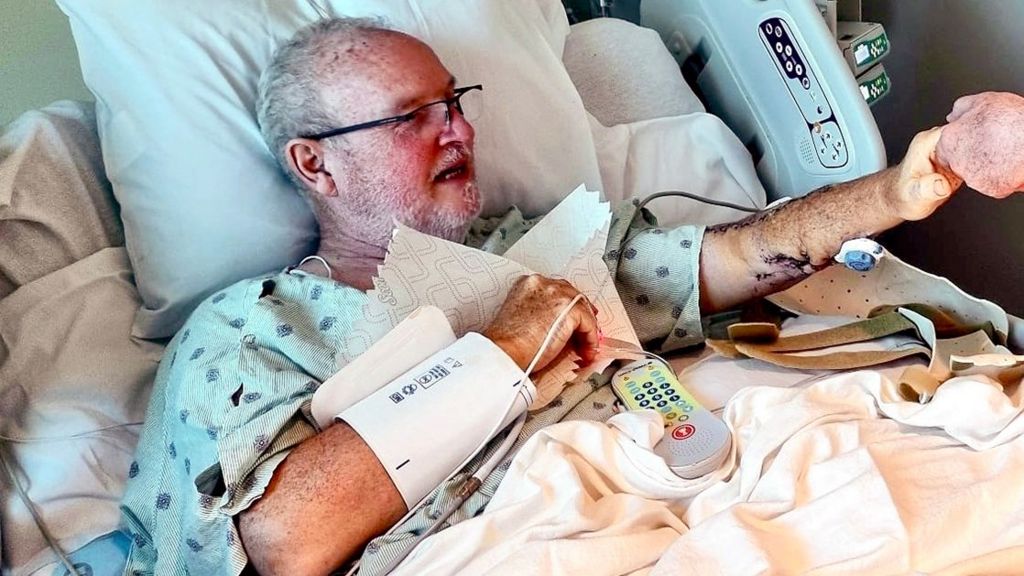
In a remarkable tale of survival and resilience, retired IT director Peter Smith from Hertfordshire recounts his harrowing encounter with a bull shark during what should have been a tranquil vacation in Tobago. The incident occurred in April 2024 during the final hours of his Caribbean holiday when he took a casual swim in waist-deep water.
Without warning, a approximately 10-foot (3m) bull shark—one of the world’s most dangerous shark species known for hunting in shallow waters—launched a brutal attack. The predator bit Smith’s leg, arm, and stomach in rapid succession, causing severe blood loss and life-threatening injuries. “Your brain works at 1,000 miles an hour,” Smith recalls of the moment he recognized the species by its distinctive jaws.
Displaying extraordinary presence of mind, the 66-year-old fought back aggressively, punching the shark repeatedly while friends in the water assisted in the struggle and raised the alarm. Bystanders eventually dragged the severely injured man to shore where his wife Joanna witnessed the devastating injuries. “I could see bones, it was just awful,” she remembers.
Medical evacuation became necessary when Tobago’s sole hospital exhausted its blood supply treating Smith’s injuries, which included deep stomach lacerations and substantial tissue loss from his upper thigh. He was transported to Jackson Memorial Hospital in Miami, Florida, where he underwent dozens of surgical procedures during a prolonged recovery.
In an ironic twist during treatment, medical staff used a shark-derived membrane to facilitate skin grafting—a detail that brought unexpected humor to his recovery process. Despite permanent nerve damage that affects hand function and mobility challenges requiring him to relearn walking, Smith maintains profound gratitude for his survival and the assistance he received.
Shark experts note that this incident represents Tobago’s first recorded shark attack according to the International Shark Attack File. Recent bull shark incidents in Australia have raised concerns, but specialists emphasize that shark attacks remain extremely rare relative to human water recreation. Tom ‘The Blowfish’ Hird, a shark expert, explains that sharks typically don’t prey on humans and often retreat when encountering resistance.
Remarkably, Smith bears no animosity toward sharks or Tobago, insisting he would return to the island and refusing to live in fear after his traumatic experience. His story stands as a testament to human resilience and the uncommon nature of such wildlife encounters.