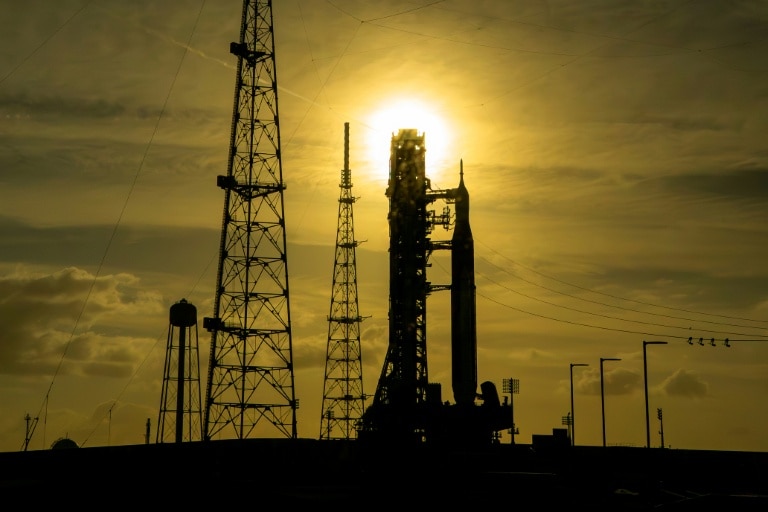
Nearly 52 years after humanity’s last crewed trip to the Moon, NASA’s groundbreaking Artemis 2 mission stands on the cusp of launch, carrying four astronauts to make history as the first crewed lunar voyage since 1972. After years of planning, multiple delays and technical setbacks have pushed the mission from its original February launch window to its targeted liftoff at 6:24 pm ET (2224 GMT) on April 1 from NASA’s Kennedy Space Center in Florida.
The four-person crew includes three NASA astronauts — mission commander Reid Wiseman, pilot Victor Glover, and mission specialist Christina Koch — plus Canadian Space Agency astronaut Jeremy Hansen. Over the course of a roughly 10-day expedition, the crew will fly a circumlunar trajectory, orbiting the Moon without landing, echoing the path of NASA’s 1968 Apollo 8 mission. This journey carries multiple historic firsts: Glover will become the first person of color to travel to the Moon, Koch the first woman, and Hansen the first non-U.S. citizen to join a lunar mission.
Artemis 2 also marks the inaugural crewed flight of NASA’s powerful new Space Launch System (SLS), a massive orange-and-white rocket built to enable repeated U.S. missions to the lunar surface in the coming decades. The long-term goal of the Artemis program is to establish a permanent lunar outpost that will serve as a launchpad for future deep space exploration, most notably a crewed mission to Mars.
Speaking at a press conference over the weekend, Koch framed the Moon as an invaluable scientific resource: “The moon is a witness plate to our entire solar system’s formation. It’s a stepping stone to Mars, where we might have the most likelihood of finding evidence of past life, but it’s also a Rosetta Stone for how other solar systems form.”
After multiple scheduling delays that required rolling the massive rocket back to its assembly hangar for technical inspections and repairs, NASA leadership says all systems are go for launch. “The vehicle is ready, the system is ready. The crew is ready,” Amit Kshatriya, NASA’s associate administrator, told reporters at a recent briefing. As of Tuesday afternoon, agency officials confirmed that final pre-launch engineering preparations were progressing on schedule, and forecasters are predicting generally favorable weather conditions for Wednesday’s attempt.
If the launch is scrubbed on Wednesday, backup launch windows remain available through April 6, though weather conditions are expected to become slightly less favorable later in the week. Launch weather officer Mark Burger noted Tuesday that meteorologists are monitoring scattered cumulus clouds, possible light showers, and gusty winds, but added that none of the potential weather hazards are expected to be severe enough to fully rule out launch. “We should be able to find some clear air to launch Artemis,” Burger said.
Thousands of space enthusiasts have traveled to Florida from across the country to witness the historic launch, including 76-year-old Melinda Schuerfranz, a retiree from Ohio who watched earlier Apollo launches from afar decades ago. “We’re looking forward to it, we’ve never seen anything like this,” Schuerfranz told AFP, while relaxing on a Florida beach. She noted that public interest is already widespread at local businesses, but reflected that the cultural moment may feel less unified than the Apollo era, when nearly all Americans tuned in for lunar launches: “I think it was way more exciting then. Everybody tuned into it.”
Despite the momentum ahead of Artemis 2, the broader Artemis program has long been plagued by costly delays and ballooning budgets. The program is under political pressure to meet the target of landing the first woman and first person of color on the lunar surface by early 2029, the end of a second presidential term if former president Donald Trump wins re-election in 2024. The primary objective of Artemis 2 is to validate the performance of the SLS rocket and the Orion crew capsule in deep space, clearing the way for the 2028 landing mission.
That 2028 landing deadline has drawn skepticism from many space policy experts, in large part because NASA is counting on private sector development of a human-rated lunar lander. Two competing lander designs are currently under development by private companies led by billionaires Elon Musk and Jeff Bezos, and the program’s timeline hinges on these projects staying on schedule.
In the broader global context, the U.S. return to the Moon is widely framed as a space race with China, which has its own crewed lunar landing program targeted for 2030. For new NASA administrator Jared Isaacman, the Artemis program pursues overlapping goals spanning scientific discovery, national security, and commercial economic opportunity, as well as intangible cultural benefits. “I guarantee after these astronauts fly around the moon, you’re going to have more kids dressing up as astronauts for Halloween,” Isaacman said during a recent television interview. “And that’s going to inspire the next generation to take us further.”