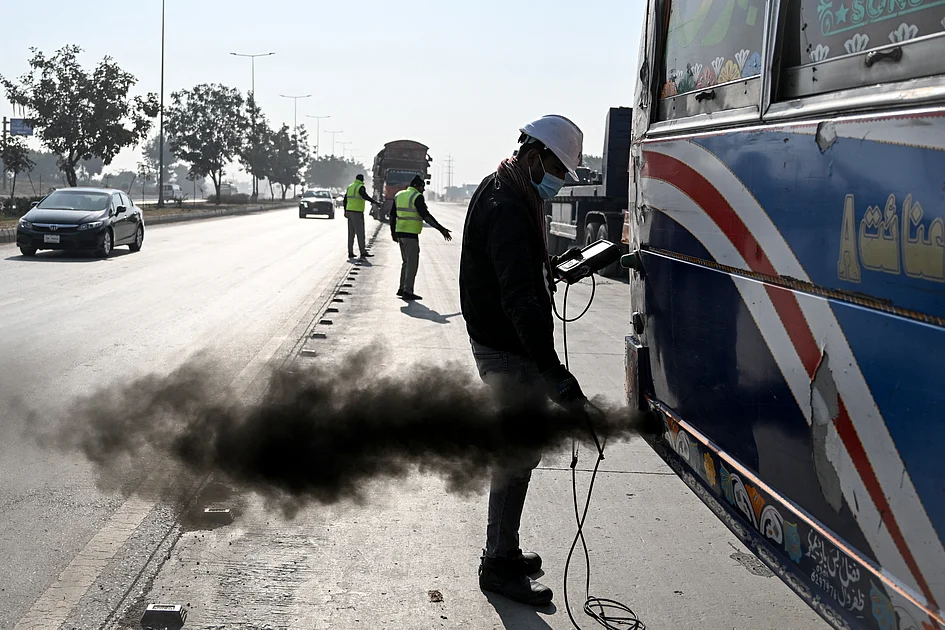
Islamabad authorities have initiated an aggressive vehicle inspection campaign to combat dangerously deteriorating air quality during the winter months. The crackdown targets smoke-emitting vehicles entering the capital, with police checkpoints issuing fines and impounding non-compliant transports.
Truck driver Muhammad Afzal became one of the first casualties of the new policy when he was fined 1,000 rupees ($3.60) for excessive diesel emissions. “This is unfair,” Afzal protested, claiming his vehicle had just been repaired in Lahore. “They pressed the accelerator to make it release smoke. It’s an injustice.”
The Environmental Protection Agency (EPA) has established inspection stations where vehicles undergo emissions testing. Those passing receive green windshield stickers, while violators face exclusion from the city. “We cannot allow non-compliant vehicles at any cost to poison the city’s air and endanger public health,” stated EPA chief Nazia Zaib Ali, reporting over 300 fines and 80 impoundments in the campaign’s first week.
Technical inspector Waleed Ahmed explained the rationale: “Just like a human being, a vehicle has a life cycle. Those that cross it release smoke that is dangerous to human health.”
Data reveals Islamabad’s air quality has reached critical levels, with seven December days already classified as “very unhealthy” by IQAir standards. PM2.5 particulate levels frequently exceed 150 micrograms per cubic meter—far beyond the WHO’s recommended safe level of 5 micrograms. Surprisingly, Islamabad’s 2024 annual PM2.5 average of 52.3 micrograms actually surpassed Lahore’s 46.2, challenging perceptions about which city suffers worse pollution.
According to the Pakistan Air Quality Initiative, transportation generates 53% of Islamabad’s toxic PM2.5 particles. The research group characterized the crisis as “the exhaust of a million private journeys—a self-inflicted crisis” rather than industrial pollution.
Residents report deteriorating health conditions. “I never needed medicine before but now I get allergies if I don’t take a tablet in the morning. The same is happening with my family,” said Iftikhar Sarwar, 51, during his vehicle inspection.
Anthropologist Sulaman Ijaz expressed generational concerns: “This is not the Islamabad I came to 20 years ago. I feel uneasy when I think about what I will say if my daughter asks for clean air—that is her basic right.”