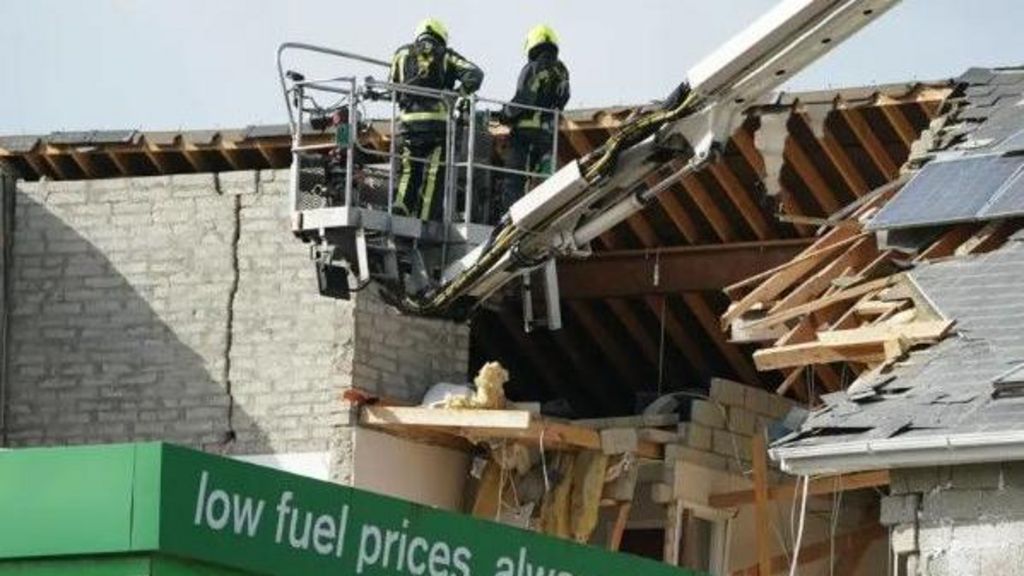
Nearly two years after a devastating explosion ripped through a small rural service station in Creeslough, County Donegal, claiming 10 lives, families of the victims are still fighting for clear answers and official accountability — and Irish officials have now signaled a potential path forward. On Thursday, 10 family representatives of those killed traveled to Dublin’s Department of Justice to meet with Justice Minister Jim O’Callaghan for a 90-minute discussion about their long-held demand for a public inquest into the disaster.
The October 7, 2022 blast killed 10 local residents from Creeslough and its surrounding communities, cutting short lives across generations: 5-year-old Shauna Flanagan-Garwe, her 50-year-old father Robert Garwe, 14-year-old Leona Harper, 13-year-old James Monaghan, his mother Catherine O’Donnell, Jessica Gallagher, Martin McGill, James O’Flaherty, Martina Martin, and Hugh Kelly. To date, investigators have not released any official public explanation for what caused the explosion. While multiple arrests have been made in connection with the ongoing investigation, no one has faced criminal charges.
Following the closed-door meeting, O’Callaghan confirmed that he would review the request for a formal inquest, echoing a longstanding government concern that launching an inquest too early could jeopardize the active criminal probe. But legal representatives for the families have pushed back, arguing that preliminary inquest work can proceed in parallel with the criminal investigation without disruption, pointing to the 1981 Stardust fire disaster inquest as a successful model that paired independent judicial review with ongoing criminal processes.
“Two years ago, these families asked for an independent investigation. We are still waiting for a decision,” Darragh Mackin, a solicitor with Phoenix Law representing several families, told reporters outside the department. He added that there is “absolutely no prohibition” on starting preparatory work for the inquest immediately, saying “the ball is now in the minister’s court.”
For the families left behind, the delay has meant being frozen in grief, unable to move forward without clarity about what caused the tragedy that took their loved ones. Donna Harper, whose 14-year-old daughter Leona died in the blast, pointed to the unmarked milestones her daughter will never get to experience — “She should have been 18 in January, she should have been making her prom” — and expressed frustration that almost four years will pass from the date of the explosion by the time any decision may come.
Harper also noted that the disaster, one of the deadliest in modern Irish history, has yet to even receive an official public memorial. “We’re going down there every year, we’re just laying flowers at the side of the road. We’re stuck on the 7th of October 2022. How do you begin to move on when you have all this in front of you? We just need some answers,” she said.
Damien Tierney, another legal representative for the families, said O’Callaghan’s primary concern is that any sworn public inquiry launched before the criminal investigation concludes could lead to injunctions filed by parties connected to the case. Tierney pushed for a timeline, asking “At what point will the government say, enough time has passed? Something now needs to be done.”
Currently, multiple Irish state bodies are conducting overlapping investigations into the explosion. Aine Flanagan, who lost her partner Robert Garwe and daughter Shauna in the blast, confirmed that a completed health and safety investigation file will be sent to the Director of Public Prosecutions (DPP) this coming July. By standard process, the DPP typically takes between three and six months to make a decision on whether to pursue criminal prosecution after receiving case files.
Anne Marie Boyle, who lost her sister Catherine O’Donnell and 13-year-old nephew James Monaghan in the disaster, said even launching preliminary inquest work now would help bring families closer to closure. “If preliminary work can get under way on the inquest it would speed things up,” she said. After two years of waiting, families remain firm in their demand for transparency, saying nothing less than a full independent inquiry will allow them to begin healing.