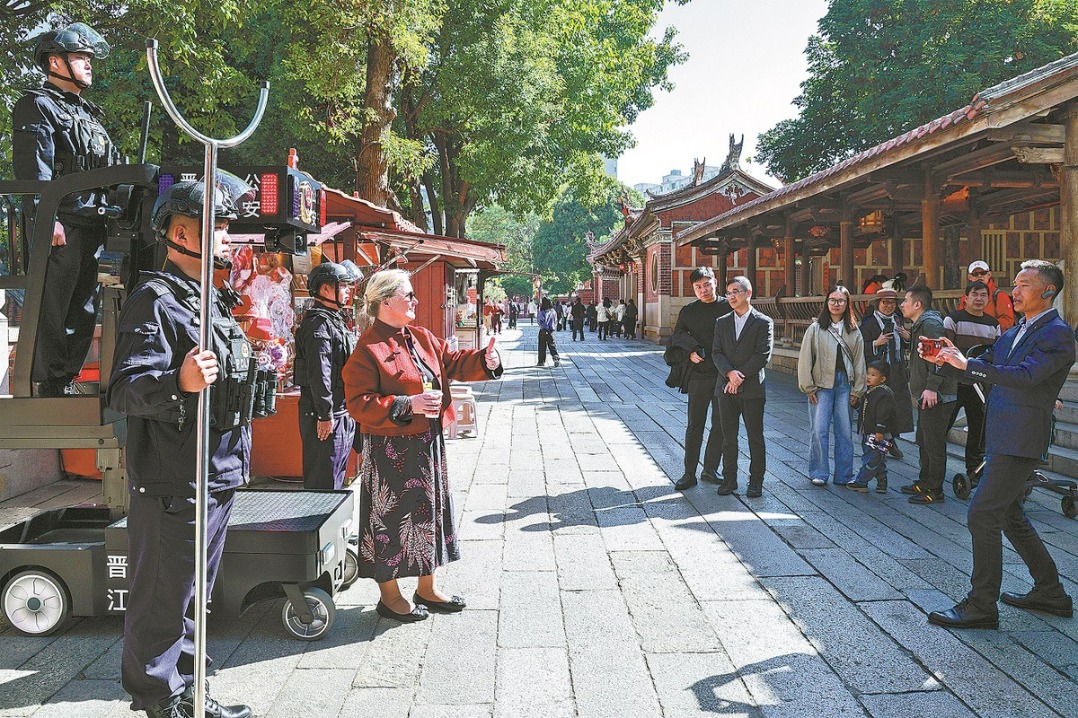
FUJIAN, CHINA – An international delegation comprising police liaisons from 11 nations and international organization representatives recently concluded an immersive four-day inspection of China’s grassroots law enforcement systems in Fujian province. Organized by China’s Ministry of Public Security from January 12-15, the program offered unprecedented access to policing operations across multiple cities, challenging conventional perceptions of law enforcement institutions.
The delegation’s itinerary included detailed examinations of police facilities in Fuzhou, Quanzhou, and Zhangzhou, where participants observed firsthand the integration of administrative services, technological innovation, and cultural sensitivity within local precincts. Brazilian Federal Police liaison officer Antonio de Padua Vieira Cavalcanti expressed surprise at the welcoming atmosphere within Chinese police stations, noting the stark contrast to more institutional environments in Brazil. “It is a very warm space where people can go to find services,” Cavalcanti remarked.
A significant focus was placed on the renowned Zhangzhou 110 model, a rapid-response unit that has gained national recognition for its community-oriented approach. Philippine embassy police attache Marcy Salting praised the unit’s compassionate methodology, stating: “It really shows how compassionate you are. I really salute all of you, and I would say that I learned a lot from it.”
The tour also highlighted China’s specialized environmental policing initiatives, with delegates visiting Luojiang district’s dedicated natural resources protection station. Jason Beatty, an attache with the United States Fish and Wildlife Service, acknowledged China’s progressive approach to ecological enforcement, particularly noting efforts in tiger conservation and mangrove restoration. “A renewed focus on environmental policing is vital for human survival,” Beatty emphasized, stressing the importance of international cooperation in preserving ecosystems.
Technological advancements formed another critical component of the demonstration, with China’s “AI Plus” initiative and big data systems for combating property crimes drawing particular interest. Sener Mavzer, counselor for security cooperation with the Turkish Gendarmerie, noted China’s impressive pace of advancement in crime prevention technology, expressing eagerness to learn from these systems.
The program concluded with strengthened commitments to international collaboration, particularly in addressing transnational crimes and environmental offenses. German Federal Police attache Stefan Korting emphasized that understanding China’s policing history and specific systems through visits to police museums was key to building “a good future” of cooperative law enforcement.