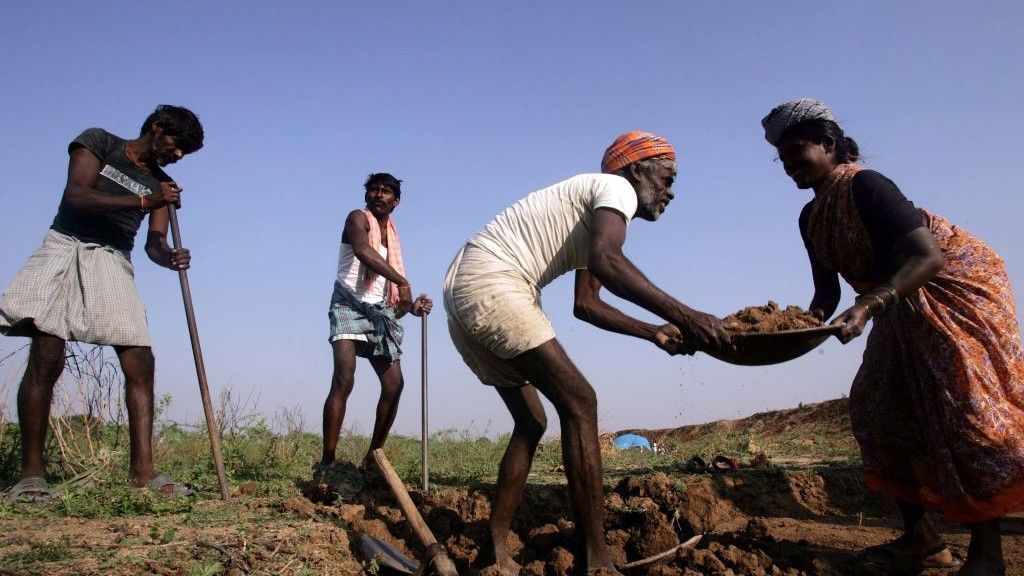
India has enacted sweeping reforms to its landmark rural employment program, fundamentally altering both its financial structure and operational framework. The National Rural Employment Guarantee Scheme (NREGS), established in 2005 as a legal entitlement to 100 days of paid manual work for rural households, has been rebranded and restructured under the new GRAM G legislation.
The revised program increases the guaranteed employment from 100 to 125 days annually per household while maintaining provisions for unemployment allowances when work isn’t provided within 15 days. However, the most significant change involves the funding mechanism: where the federal government previously covered 90% of costs, states must now contribute 40% of project expenses under a 60:40 split arrangement.
This transformative social program serves as a critical economic stabilizer for rural India, where 65% of the nation’s 1.4 billion population resides and nearly half depend on agriculture—a sector contributing merely 16% to GDP. The scheme has demonstrated remarkable equity metrics, with women comprising over half of its 126 million workers and 40% originating from historically marginalized scheduled castes or tribes.
The Modi administration frames the reforms as modernization efforts to enhance effectiveness and reduce corruption. Federal Agriculture Minister Shivraj Singh Chouhan asserts the legislation “stands firmly in favour of the poor, in support of progress, and in complete guarantee of employment for the workers.”
Conversely, development economists, opposition parties, and international experts have raised substantial concerns. Critics argue the funding shift could undermine the program’s constitutional mandate, effectively transforming a legal right into a discretionary scheme. Development economist Jean Dreze characterizes the increased day guarantee as a “red herring,” noting that only 7% of households received the full 100 days of work in 2023-24.
The program’s documented impacts remain substantial despite implementation challenges. Research indicates NREGS boosted beneficiary household earnings by 14% and reduced poverty by 26% through economy-wide effects. The scheme has particularly proven vital during crises, most notably during COVID-19 pandemic reverse migration events.
Underlying these reforms persists India’s structural employment challenge: the chronic inability to generate sufficient non-farm jobs to absorb surplus rural labor. Recent economic analyses suggest rising labor participation rates may reflect economic distress rather than quality job creation, with increases concentrated in low-productivity subsistence work.
The program’s future effectiveness hinges on navigating these complex financial, administrative, and structural challenges while preserving its core mission of supporting vulnerable rural populations.