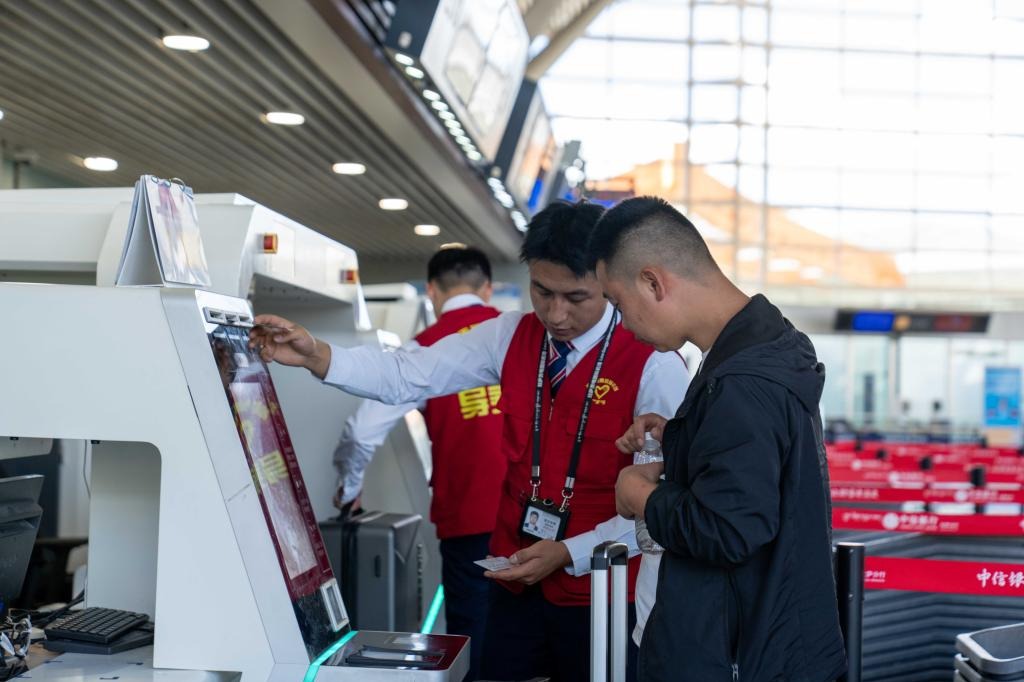
LHASA — Marking a historic milestone in its transportation development, Southwest China’s Xizang Autonomous Region has recorded an unprecedented annual passenger throughput exceeding 8 million in 2025. This achievement represents the culmination of six decades of aviation progress on the Tibetan Plateau, where air travel has evolved from a rare spectacle to an integral part of regional connectivity.
The regional civil aviation authorities project approximately 71,000 flight operations for the year, reflecting a 6 percent increase from previous records. Passenger transport volume has grown by 5.7 percent, while cargo and mail handling has surged by 7.7 percent, demonstrating robust expansion across all aviation sectors.
This exponential growth stands in stark contrast to March 1965, when the region’s inaugural civil aviation flight touched down at Damxung airport. The Soviet-made Il-18 aircraft, having departed Beijing with a stopover in Chengdu, initiated what would become a transformative chapter in Tibetan transportation history.
Damxung airport, situated at 4,230 meters above sea level, pioneered high-altitude aviation as China’s first airport operating above 4,000 meters. However, operational challenges stemming from extreme weather conditions and considerable distance from Lhasa prompted the development of Lhasa Konggar International Airport (LKIA) in 1966. Located in the more accessible Yarlung Zangbo River valley at approximately 3,500 meters elevation, LKIA has since evolved into the region’s primary aviation hub.
Early aviation operations faced significant logistical challenges. Hu Jinfa, a retired official from the regional Civil Aviation Administration, recounted how staff and passengers would collectively clear snow and ice from runways using basic tools to maintain flight schedules during harsh winter months.
Initially serving government officials, medical patients, and pregnant women who couldn’t endure overland journeys, air transport also facilitated the delivery of essential goods previously scarce on the plateau. Today, the region’s aviation network has expanded dramatically to encompass 193 routes connecting 81 cities through eight civil airports.
The transformation extends beyond passenger services to cargo operations. Inbound shipments now include perishable goods, temperature-sensitive pharmaceuticals, and high-value products, while outbound flights carry an increasing volume of Tibetan specialties such as cordyceps sinensis, yak meat, barley products, traditional medicines, and handicrafts.
Customs official Zhang Wei noted the strategic role of Xizang’s aviation infrastructure: “Not only are unique Tibetan products reaching markets across China, but quality goods from across the country are also reaching South Asian markets through Xizang’s flights.”
The tourism sector has been a primary beneficiary of improved aviation access. Ngari Prefecture, among the region’s most remote areas, welcomed 2.5 million domestic and international visitors in 2024—a 40-fold increase since the opening of Ngari Gunsa Airport in 2010.
Simultaneously, air travel has enabled growing numbers of Tibetan residents to explore educational, employment, and tourism opportunities elsewhere in China. At LKIA’s departure hall, 68-year-old Padma Dondrup embodied this new mobility as she prepared to accompany her granddaughter to university in Shanghai, fulfilling her lifelong dream of witnessing the iconic Bund waterfront firsthand.