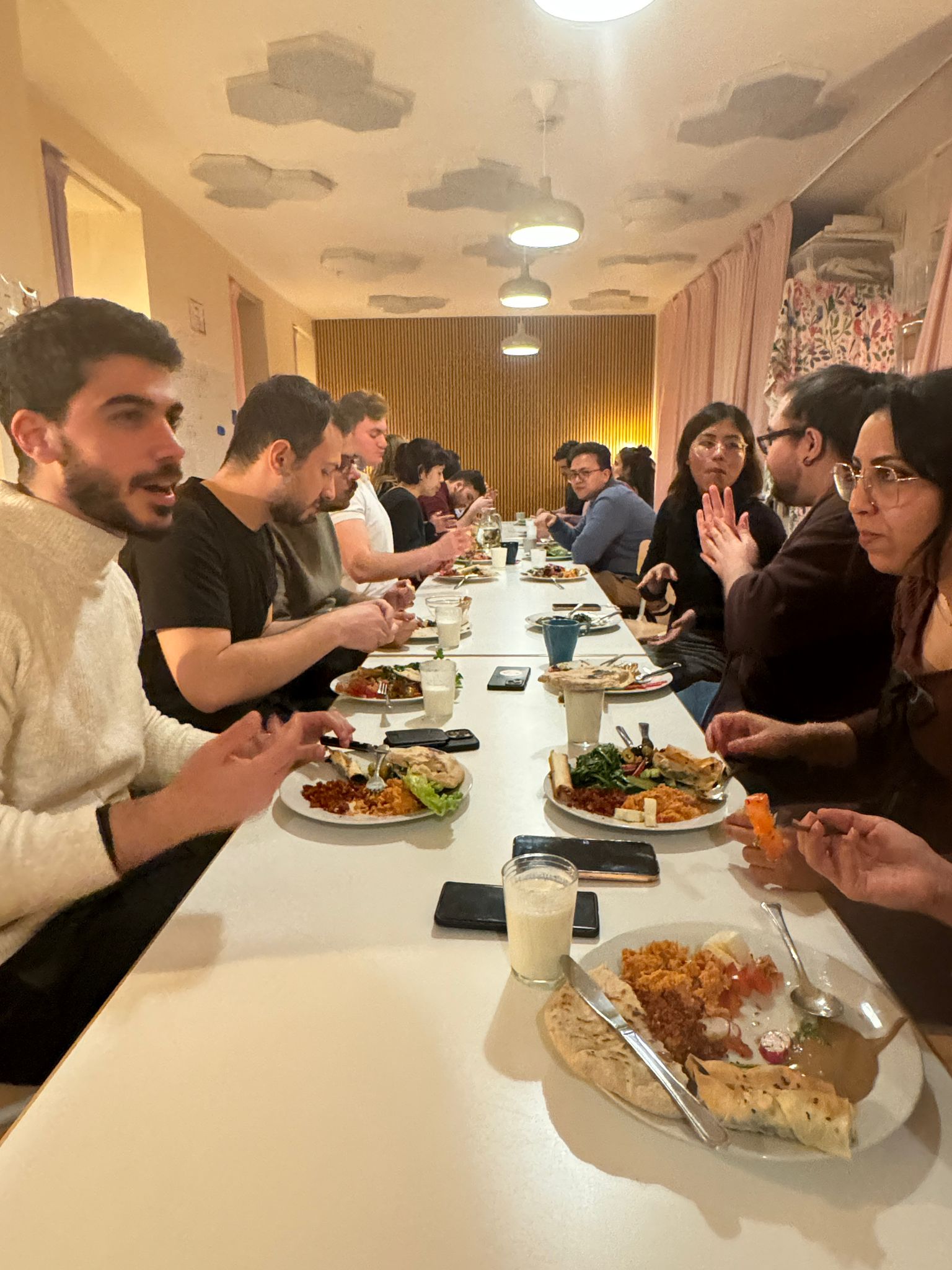
Nestled in Berlin’s multicultural Neukölln neighborhood, along the bustling Sonnenallee — a street dotted with Middle Eastern grocery stores and the aroma of exotic spices — a team of Open Kitchen volunteers moves methodically through the aisles of a popular Arab supermarket. On this particular Thursday, they are hand-picking crisp seasonal vegetables, earthy nuts, and plump green and black olives, preparing for a very special weekly feast: a traditional Turkish kahvalti breakfast that will welcome 30 guests from every corner of the globe. This gathering, held every week at 5:30 p.m., is more than a shared meal; it is the heart of a decade-long mission to build belonging for migrants and refugees in Germany’s capital.
Founded in 2013 and run by local NGO Hejmo, Open Kitchen is far more than a community cooking project. Over the past 13 years, it has explored culinary traditions from every continent, hosting pop-up feasts in venues ranging from world-class museums to the sprawling public park of the former Tempelhof Airport. Neukölln, the neighborhood that calls to Open Kitchen home, mirrors the project’s mission: as one of Berlin’s most diverse districts, it blends Turkish grand bazaar-style import shops with Levantine and Anatolian community spaces, where the tang of Aleppo pepper mixes with fresh fruit scents, and multilingual signage marks a thriving enclave of migrant culture.
This cultural richness is not unique to Neukölln. Of Berlin’s nearly 3.9 million residents, roughly one quarter — 976,000 people — are foreign-born nationals hailing from more than 190 countries. Waves of displacement, from the Syrian civil war to the war in Ukraine, have reshaped the city’s demographic landscape in recent decades, and integration has emerged as one of Germany’s most pressing social challenges. Newcomers often face systemic barriers: a notoriously complex bureaucracy, endless forms and permits, language gaps, and a formal administrative system that even native German speakers struggle to navigate. Many end up isolated, cut off from the social connections that make a new place feel like home. It is this gap that Open Kitchen was built to fill.
“We try to make it as easy as possible for people to arrive here,” explains Ricarda Bochat, the project’s 41-year-old German coordinator, who has been part of Open Kitchen since 2015. “You do not have to be able to do anything or bring anything with you. You just need to want to come here. We don’t need a common language; we do not have to have anything in common except for coming together to eat. Eating together creates very quickly and easily a very intimate space. Food, the smells and recipes bring back memories and urge people to tell stories.” Bochat frames the initiative as an alternative to Germany’s rigid, exclusionary integration system, one that centers human connection over paperwork and checkboxes.
On this kahvalti-themed week, regular cook Nigel Menezes, a 28-year-old Australian-Malaysian who has lived in Berlin for five years, is prepping his first spinach borek, a flaky, spiced pastry that originated in Central Asia and spread across the Ottoman Empire to become a staple of Turkish breakfast. For Menezes, living in a city that hosts the world’s largest Turkish diaspora — a community whose roots stretch back to the 1960s and 70s, when Turkish guest workers were recruited to rebuild post-WWII West Germany — has been a revelation. Cooking at Open Kitchen, he says, has taught him a fundamental truth about human connection.
“Our shared passion for food and the desire to make it tasty are a great testament to how we can break down cultural barriers and come closer together as humans in a harmonious community,” Menezes says. As he rolls his borek and lines the pastries on a baking tray, he reflects on the context that makes Open Kitchen’s work more urgent than ever: across Germany, far-right sentiment has surged to its highest level since World War II, with the anti-migrant Alternative for Germany (AfD) now the country’s second-largest parliamentary party. The AfD has pushed the inflammatory policy of “remigration,” a euphemism for mass deportations, and frames Islam and Muslim migration as an “existential danger” to German society. Polls show the party could win an outright regional majority in Saxony-Anhalt in September, a historic first for a far-right party in post-WWII German politics. Even mainstream Chancellor Friedrich Merz has echoed anti-migrant rhetoric, drawing widespread criticism for invoking the historically charged phrase “large-scale deportations” to address migration issues.
Against this rising tide of xenophobia, Open Kitchen stands as a quiet act of resistance. “In times of increasing isolation, polarisation, loneliness, hatred and fear, it is so important to have spaces that can counteract that narrative,” Bochat says. “That space takes us out of fear and bring us into the joy of connecting. That is quite a radical thing to do right now, not just to keep doing but keep growing and learning. The people are reminded of humanity and that is profound in times when everything is driven by fear.”
For the volunteers and guests who gather every week, that radical connection is life-changing. Limin Malek, a 30-year-old Polish volunteer of Chinese descent who has been part of the project for three years, says the space lets him share part of his own identity while learning from others. “Personally, volunteering gives me the opportunity to be more involved and closer to the recipe creation process; in a way, I wanted to share a part of myself this way,” he explains. His Sichuan-style Yuxiang Qiezi (fish-fragrant eggplant) has become a crowd favorite, with guests repeatedly asking for the recipe to recreate it at home. “It is deeply individual and tied to memories of family, identity and culture. I feel grateful to be exposed to so many culinary traditions and ingredients from people of different backgrounds,” Malek says. “The real magic is not in the dish itself; it is in the shared act of cooking and eating, which creates the space for community to form.”
Even Bochat, who has overseen the project for nearly a decade, says she gains as much as she gives. “I do not do this job to facilitate for others only, for myself as well. It is also fun, I learned so much about so many ways of seeing the world, so many different recipes, so different stories. And I have never been bored,” she says.
As the clock strikes 8 p.m., Menezes joins the queue for the communal meal, savoring his crispy borek, a ricotta salad prepared by Malek, and a final course of molasses and tahini sweet dessert. For him, as for many participants, Open Kitchen is more than a project — it is home. “There is a reason why I keep coming back every time, because this is a space where I feel I can share my love of food with others, and they can do the same with me. I feel more connected to people and less lonely here,” he says. “An initiative like the Open Kitchen really brings us closer to a more peaceful world, or at least, a peaceful Berlin.”