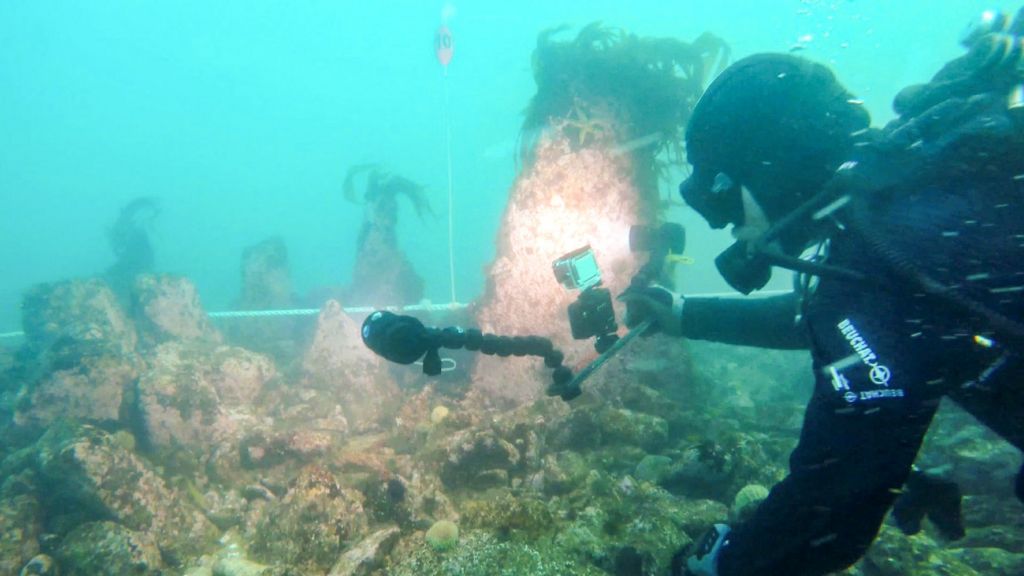
French marine archaeologists have uncovered a monumental submerged structure off the coast of Brittany, revealing sophisticated engineering from a prehistoric society that vanished beneath rising seas approximately 7,000 years ago. The massive 120-meter (394-foot) wall, constructed around 5,000 BC, represents the largest underwater construction ever discovered in France and may provide the historical basis for ancient Breton legends of sunken cities.
The structure, located off the Ile de Sein at Brittany’s western extremity, now rests under nine meters of water but originally stood at the shoreline between high and low tide marks. With an average width of 20 meters and height of 2 meters, the wall features an impressive construction technique involving large granite standing stones arranged in two parallel lines that protrude above the main structure. These monoliths were strategically placed on bedrock before being surrounded by carefully arranged slabs and smaller stones, creating a durable design that has withstood millennia of marine conditions.
Archaeologists propose two primary theories for the wall’s function: an elaborate fish-trapping system or a protective dyke against rising sea levels. If used for fishing, the protruding monoliths would have supported a network of sticks and branches that captured fish as tides receded. The sheer scale of the construction—weighing approximately 3,300 tonnes—indicates it was built by a substantial, organized community with advanced technical capabilities for its time.
The discovery emerged after local geologist Yves Fouquet identified anomalous features on underwater depth charts created with advanced radar technology. Subsequent archaeological investigations in 2022 confirmed the artificial nature of the structure, though researchers had to wait until winter when seaweed coverage diminished to properly map the site.
Notably, the wall’s construction predates the famous Neolithic menhirs that dot the Brittany landscape, suggesting possible knowledge transfer between older Mesolithic hunter-gatherers and incoming Neolithic agricultural populations. According to archaeologist Yvan Pailler, this finding challenges previous assumptions about the technological capabilities of prehistoric societies.
In a paper published in the International Journal of Nautical Archaeology, researchers speculate that such submerged sites may have inspired local legends of sunken cities, particularly the myth of Ys believed to lie in the nearby Bay of Douarnenez. The rapid sea level rise that submerged this developed territory likely left a profound cultural memory that persisted through generations, eventually evolving into the mythological narratives that endure in Breton folklore today.