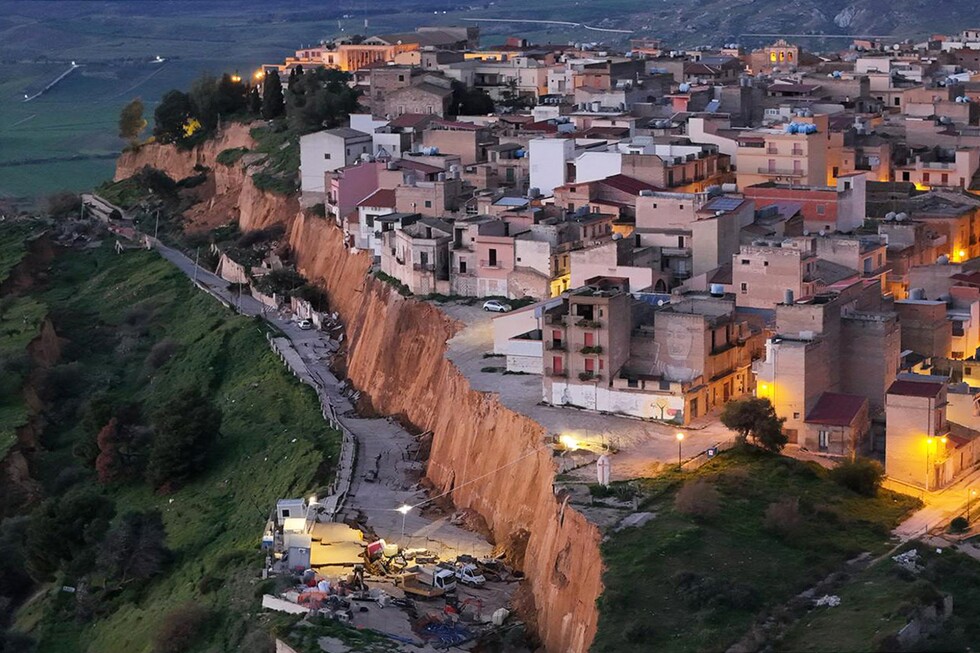
The southern Sicilian town of Niscemi has become the epicenter of a geological disaster following Cyclone Harry’s torrential rains, which triggered a massive landslide that severed the town’s perimeter and displaced approximately 1,500 residents. Italian Premier Giorgia Meloni conducted an aerial assessment of the devastated area on Wednesday, surveying the 4-kilometer (2.5-mile) landslide zone where entire structures have plummeted 20 meters from unstable cliffs.
Civil Protection Chief Fabio Ciciliano confirmed the alarming geological reality: “The entire hill is collapsing onto the plain of Gela. Houses positioned along the landslide edge are permanently uninhabitable, necessitating permanent relocation solutions for affected families.” Authorities have established a 150-meter-wide exclusion zone as the water-saturated terrain continues to shift unpredictably.
This catastrophe has exposed longstanding geological vulnerabilities in Niscemi, where the town’s foundation of sand and clay layers becomes dangerously permeable during heavy rainfall. University of Catania geology professor Giovanna Pappalardo emphasized the unprecedented scale: “The current landslide front extends approximately 4 kilometers and directly impacts slope-facing residences, representing a significant escalation from previous events.”
The disaster has ignited political confrontations regarding construction approvals in geologically high-risk areas. While Sicilian regional president Renato Schifani acknowledged legitimate concerns about building permissions, opposition leader Elly Schlein proposed redirecting 1 billion euros from the controversial Sicily-mainland bridge project—currently stalled in legal challenges—toward emergency relief efforts.
The federal government has declared a state of emergency for southern regions, allocating an initial 100 million euros ($120 million) for immediate response. However, Sicilian officials estimate total damages could reach 2 billion euros ($2.4 billion), highlighting the substantial gap between initial funding and actual recovery needs.