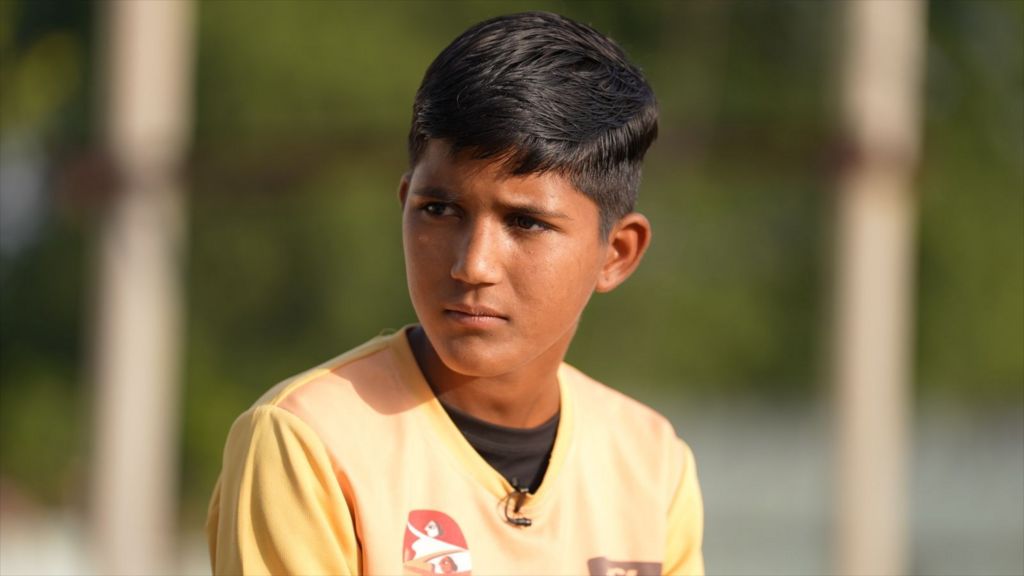
In the arid landscapes of Rajasthan, a powerful social transformation is unfolding through the unlikely medium of football. Nisha Vaishnav, a 15-year-old from Padampura village, has become an emblem of resistance against entrenched child marriage practices by pursuing her athletic ambitions against formidable cultural odds.
The journey began when Nisha’s sister Munna introduced her to Football for Freedom in 2022, a grassroots initiative under the Mahila Jan Adhikar Samiti organization that uses sports empowerment to combat systemic gender inequality. The program faced immediate cultural challenges, with villagers criticizing the girls for wearing shorts instead of traditional modest attire. Munna, now 19, recalls the initial stigma: “Village women would point to us saying ‘Look at those girls exposing their legs.’ We ignored them and continued wearing shorts.”
Nisha’s athletic prowess quickly became apparent as she ascended to Rajasthan’s state football team by 2024, simultaneously defying gender norms by cutting her hair short—a symbolic act of rebellion in a community where long hair represents traditional femininity.
The football pitch became an unexpected battleground for marital autonomy when, during practice sessions, Nisha attracted unwanted attention from families seeking child brides. In one notable incident, five adults including prospective in-laws photographed her during training. When her mother instructed her to touch their feet as a gesture of respect to marriage proposers, Nisha refused—a radical act in a region where UNICEF reports child marriage rates exceed national averages.
Her resistance proved successful when, after sustained opposition, the marriage proposal was withdrawn. The sisters later collectively rejected another joint marriage proposal involving their younger brother in 2025. When their father questioned if Nisha had a romantic interest at football practice, she defiantly responded: “There is no lover. I am going to play football – that is my love.”
The structural challenges remain deeply entrenched. Poverty and tradition perpetuate the practice, with girls often viewed as financial burdens. The sisters’ mother Laali, herself a child bride, represents the generational divide, expressing concerns about daughters being “exposed to bad influences” without early marriage. She acknowledges the illegality of child marriage while explaining how communities circumvent detection: “We do it quietly, without wedding invitations or decorations.”
Legal frameworks prescribe severe penalties—up to two years imprisonment and 100,000 rupee fines for facilitators—yet enforcement remains inconsistent. While reported cases have increased from 395 in 2017 to 1,050 in 2021, this represents a fraction of the estimated 1.5 million underage marriages occurring annually.
Football for Freedom coordinator Padma Joshi emphasizes the program’s strategic approach: “We never explicitly stated we were introducing football to stop child marriage.” Instead, they highlight tangible benefits like public sector job reservations for athletes—a powerful incentive in economically marginalized communities.
The initiative has trained approximately 800 girls across 13 villages since 2016, creating alternative pathways through education and athletic achievement. Munna now pursues a university degree while coaching younger participants, aspiring to become a sports teacher. Nisha aims for the national team or government employment, recognizing that sustained athletic performance until university completion could secure financial independence.
Their triumphs extend beyond personal success—the team secured first place in the October 2025 under-17 State Level School Games, demonstrating how athletic excellence can redefine traditional expectations. As Munna articulates the program’s philosophy: “Whether I can stop their marriages or not, I want to help these girls become something in life, realize their dreams.”