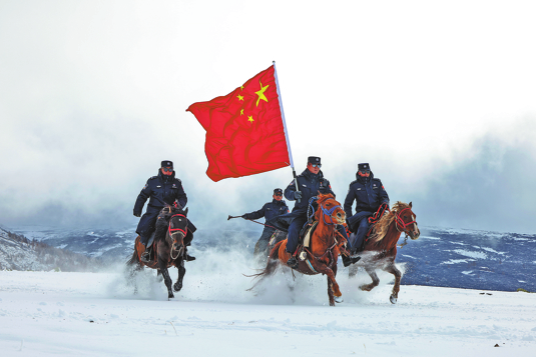
In the formidable Altay Mountains of China’s Xinjiang Uygur Autonomous Region, a specialized unit of border police has adapted to one of the country’s most challenging environments through an unexpected tool: horses. Operating from the Kanas Scenic Area Border Police Station at 1,324 meters above sea level, these officers patrol 817.63 square kilometers of rugged terrain bordering Kazakhstan, Russia, and Mongolia.
The region transforms into a treacherous winter landscape for half the year, with temperatures plunging to -30°C and snowdrifts reaching three meters deep. Under these extreme conditions, conventional vehicles become useless, forcing officers to rely on equestrian patrols to maintain border security and provide emergency services.
Station chief Zhu Peicai, a 15-year veteran of these harsh conditions, emphasizes that ‘riding a horse is as essential for us as driving a police car.’ His team of 24 officers and seven auxiliary personnel—with an average age of 29—serves a diverse community of 1,037 residents from six ethnic groups, approximately 80% of whom are Mongolian.
The dangers these officers face are substantial. Beyond the constant threat of avalanches and hidden crevasses, they regularly rescue tourists lured by the area’s spectacular winter beauty but unprepared for its dangers. In October alone, the station rescued over 140 stranded visitors, including a major operation on October 1 when 110 tourists became trapped in the remote Black Lake area without communication capabilities.
Officer Wang Yicheng describes the patrols as essential preventive measures: ‘Once the snow falls and freezes, the trail often becomes a death trap. Without a telephone signal, anyone stranded faces hypothermia within hours.’
The physical toll on officers is severe, with some experiencing such intense saddle sores from extended missions that they must sleep on their stomachs for days. The team also recalls near-fatal incidents, including a harrowing avalanche in January last year that buried 200 meters of road and trapped over 1,000 tourists.
Beyond emergency response, the officers serve as community mediators and grassroots administrators. A simple wooden table outside their station has become a hub for dispute resolution, with a remarkable 100% mediation success rate. Their annual accomplishments include handling over 900 rescue calls, saving more than 300 tourists and herders, and recovering approximately 4 million yuan in economic losses.
Despite the isolation and danger, these officers have developed a profound commitment to their mission. As Political Commissar Wang Jia expressed after planting the national flag at the China-Russia border marker: ‘Standing there, seeing the flag flutter against the snow, every ache is worth it.’