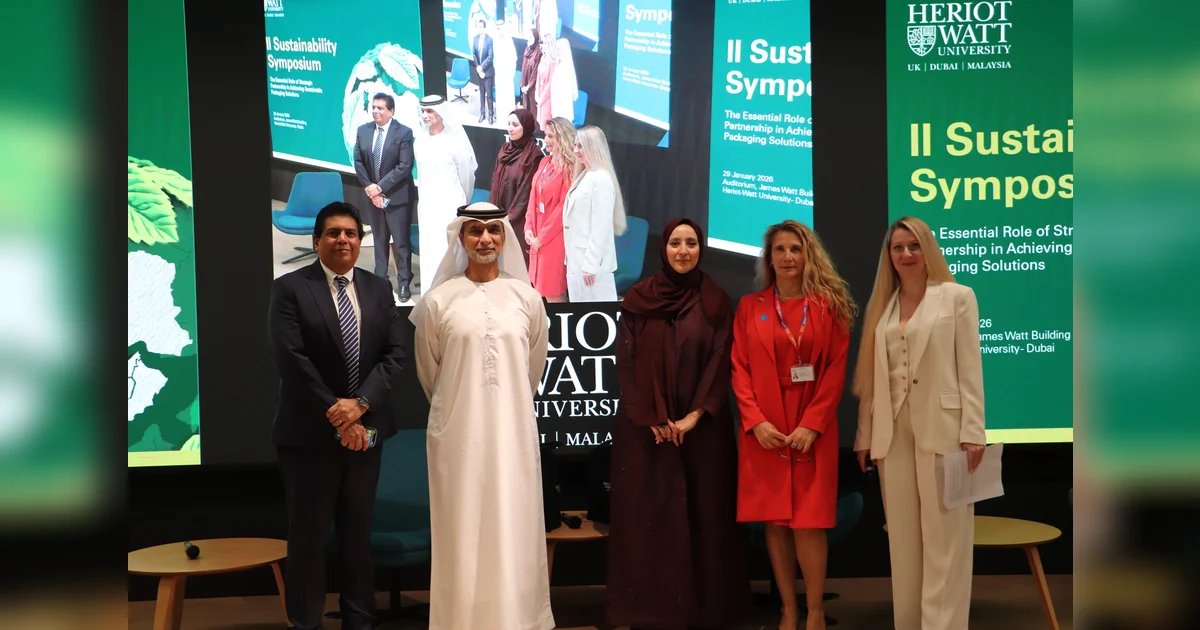
Heriot-Watt University Dubai has successfully concluded its second annual Sustainability Symposium, creating a pivotal platform for addressing one of the most pressing environmental challenges of our time. The February 2026 gathering united academics, industry pioneers, policy architects, humanitarian organizations, and students under the thematic focus “The Essential Role of Strategic Partnerships in Achieving Sustainable Packaging Solutions.”
The symposium built upon the foundational work initiated in 2024, emphasizing that sustainable packaging transformation cannot occur through isolated efforts. Through expert keynote presentations, real-world business case studies, and dynamic panel dialogues, participants explored practical methodologies for post-consumption waste management, emerging sustainable materials, and scalable solutions applicable to both commercial and humanitarian supply chains.
Dr. Matthew Sukumaran, Chief Operating Officer of Heriot-Watt University Dubai, emphasized the institution’s dedication to converting theoretical concepts into actionable environmental solutions. “This platform actively bridges the gap between academia and implementation by bringing together diverse stakeholders,” Sukumaran noted. “Strategic partnerships form the cornerstone of meaningful progress in sustainable packaging, demonstrating how collective action generates measurable, scalable impact.”
Maher Al Kaabi, Advisor to the Group Chairman of Al Serkal Group and UAE Circular Economy Council member, delivered a keynote address highlighting the multidimensional nature of packaging sustainability. “Addressing sustainable packaging demands synergistic alliances that integrate scientific innovation, industrial capability, regulatory frameworks, and humanitarian considerations,” Al Kaabi stated. “Academic institutions like Heriot-Watt play crucial roles in translating research into circular solutions that support national sustainability objectives while delivering economic and environmental value.”
The symposium featured deep-dive examinations of critical packaging challenges, including the complexities of collection systems, segregation technologies, and recycling infrastructure. Discussions also covered advancements in biodegradable and compostable materials alongside adaptations of international best practices for regional implementation.
A standout feature was the presentation of the II Design Competition outcomes, where Heriot-Watt students developed applied solutions for Expo City Dubai’s post-consumption waste management and sustainable packaging for humanitarian supply chains. These student projects, created in collaboration with Dubai Humanitarian and Othalo, demonstrated how innovative design thinking combined with strategic partnerships can produce tangible environmental benefits.
The event reinforced Heriot-Watt University’s position as a convening force in sustainability discourse, actively supporting the UAE’s circular economy objectives through knowledge exchange, partnership facilitation, and practical innovation.