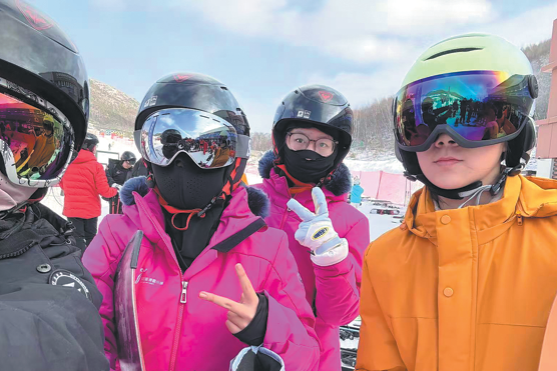
While most university students embrace winter break as a period of relaxation, a pioneering cohort at Hebei’s Tianshu Academy embarked on an entirely different journey—mastering Olympic-grade ski slopes while advancing their academic pursuits. This innovative educational model represents a significant milestone in China’s educational development strategy.
Located in Huailai county, Tianshu Academy operates as a specialized branch campus of Beijing Information Science and Technology University (BISTU), established under the Beijing-Tianjin-Hebei coordinated development initiative. The academy welcomed its inaugural class of 500 students in September 2025 following comprehensive cooperation agreements finalized in 2024.
The institution’s creation embodies what faculty and local residents describe as the “Winter Olympic spirit,” with its state-of-the-art facilities constructed within an impressive two-year timeframe. Currently spanning 10.9 hectares, the campus is already scheduled for substantial expansion that will more than double its construction area to accommodate increasing demand.
Beyond its headline-grabbing skiing curriculum that allows training during weekends and holidays, Tianshu Academy’s core mission addresses deeper academic and economic objectives. BISTU has established three specialized research institutes on-site—focused on advanced manufacturing, new energy, and the data economy—specifically tailored to Zhangjiakou’s regional development needs.
According to Xie Jiangling, Party Chief of BISTU, the Zhangjiakou branch campus demonstrates the university’s commitment to supporting national strategies for regional coordinated development. “The university’s development needs are closely aligned with national and regional strategies,” Xie emphasized, noting that BISTU leverages its strengths in intelligent equipment, robotics, and big data to meet local industrial upgrading demands while enhancing its academic standards and influence.
The initiative addresses a crucial national priority: strengthening higher education in Hebei province, where educational resources have historically trailed behind those of Beijing and Tianjin. This development aligns with China’s broader 2035 blueprint for establishing educational leadership.
Students like Guo Jiahao, a financial management major, benefit from the academy’s flexible credit system that enables exploration beyond their primary disciplines, including science and engineering courses. Meanwhile, local officials recognize the university’s potential to accelerate technological conversion. Zhang Qi, Party Secretary of Huailai county, noted that the institution’s research capacity and talent pool align perfectly with regional industrial goals, providing the necessary “brainpower” to transform scientific innovations into practical applications, positioning Huailai as an innovation hub.