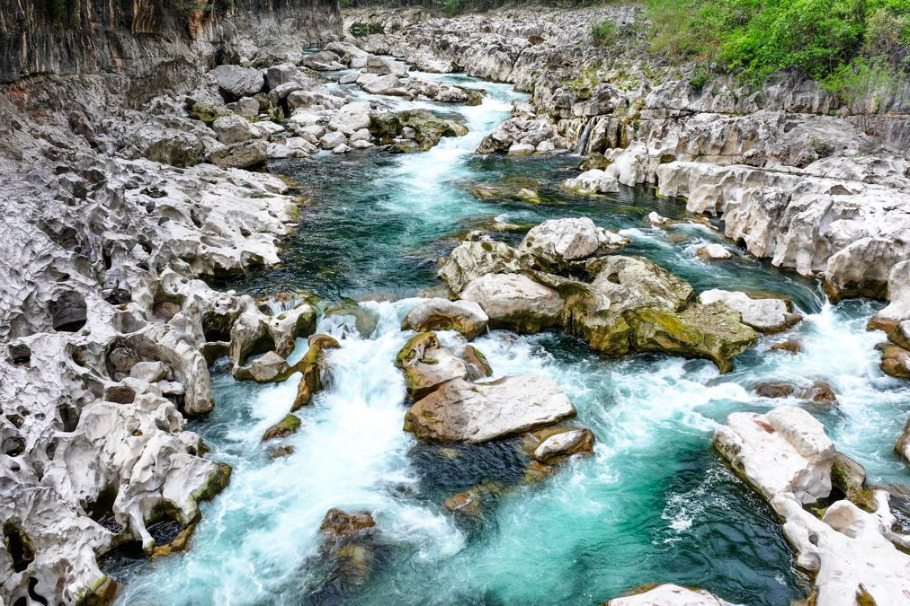
Tucked away in the karst landscapes of Anlong county, in China’s mountainous Guizhou province, a rare geological formation shaped by prehistoric ice offers visitors a view that feels straight out of another world. Aerial imagery captured on April 1 reveals the sprawling field of kamenitzas — more commonly called giant’s kettles — that dot the terrain, their unusual shapes drawing the eye of both casual travelers and earth science experts alike.
These unique hollow rock formations are not the product of ordinary erosion. Geologists confirm they were carved over thousands of years by the powerful swirling action of glacial meltwater at the end of the last ice age. Most giant’s kettles follow a consistent, distinctive shape: narrow and tapered at the opening, they widen into rounded, bowl-like cavities deeper down, a structural signature that serves as tangible, on-the-ground evidence of large-scale ancient glacial activity across the Guizhou region.
Unlike many other prehistoric geological sites that have been damaged by human development or climate shifts, this Anlong county giant’s kettle field remains almost entirely undisturbed. It retains its original natural state, with clear deep blue water pooling in the cavities of the formations to create a striking visual contrast against the surrounding rock. In recent years, the site has grown in popularity among outdoor recreation communities, emerging as a top destination for cross-country hikers, landscape photographers, and geology enthusiasts eager to explore a well-preserved piece of Earth’s glacial history up close.