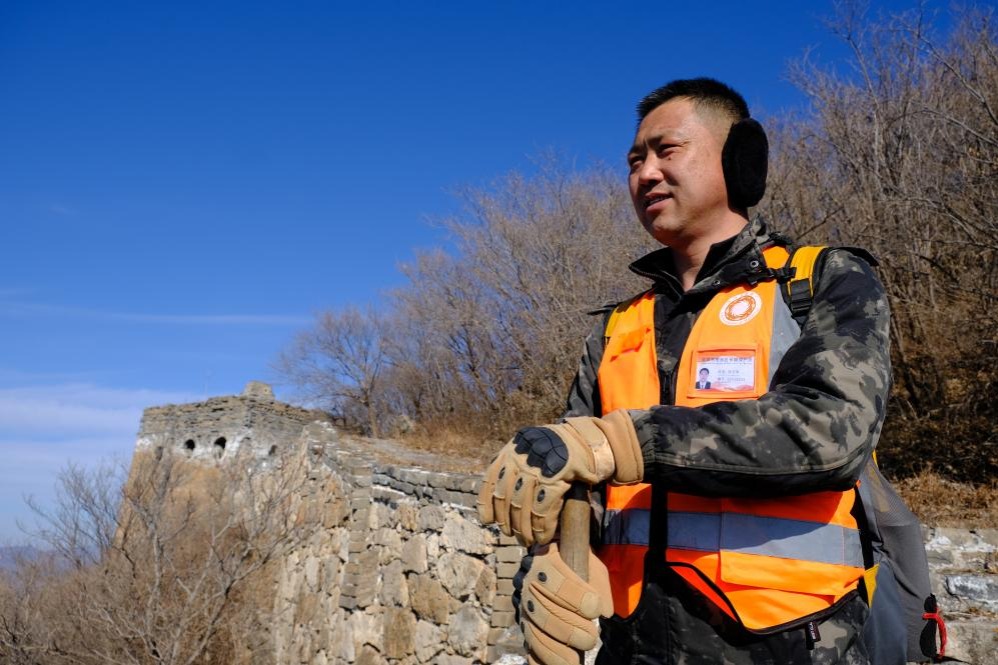
In the rugged mountains of Beijing’s Miyun district, Zhou Wenjun embarks on his daily pilgrimage along the Simatai section of the Great Wall, carrying specialized tools and a profound sense of historical responsibility. For fourteen consecutive years, this local villager has dedicated himself to protecting one of China’s most challenging architectural marvels—a steep Ming Dynasty (1368-1644) structure where some slopes exceed 70 degrees, requiring climbers to ascend on all fours.
Zhou’s conservation methodology demonstrates remarkable precision. He exclusively employs a flat-head shovel to clear drainage channels of leaves and branches, consciously avoiding pointed or rounded tools that might damage the ancient masonry. “Every brick here is a treasure,” Zhou emphasizes during his multi-kilometer patrols, where he meticulously collects displaced bricks from surrounding woodlands—some bearing inscriptions dating back to 1577 that document the soldiers and craftsmen who originally constructed the wall nearly 450 years ago.
His 10-kilogram backpack contains essential preservation equipment: water, snacks, trash bags, measuring tape, and first-aid supplies. Beyond structural maintenance, Zhou assists visitors and monitors potentially damaging behaviors. His estimated 10,000 kilometers walked along the wall represent just one aspect of his expanding conservation efforts.
Zhou has pioneered digital preservation through livestreaming broadcasts that reach over 70,000 followers. His explanations of defensive architectures and ancient border guards’ daily lives have earned him recognition as a knowledgeable “farmer anchor” disseminating cultural heritage knowledge.
The Simatai protection team now comprises 22 members, predominantly local villagers, forming part of Beijing’s broader network of 380 dedicated Great Wall guardians. Their conservation work will gain strengthened legal support next month with new capital regulations specifically addressing Great Wall preservation.
Despite the physical demands, Zhou’s commitment has evolved from occupation to life purpose. Through both physical safeguarding and digital education, he ensures global recognition of this UNESCO World Heritage site’s enduring significance.